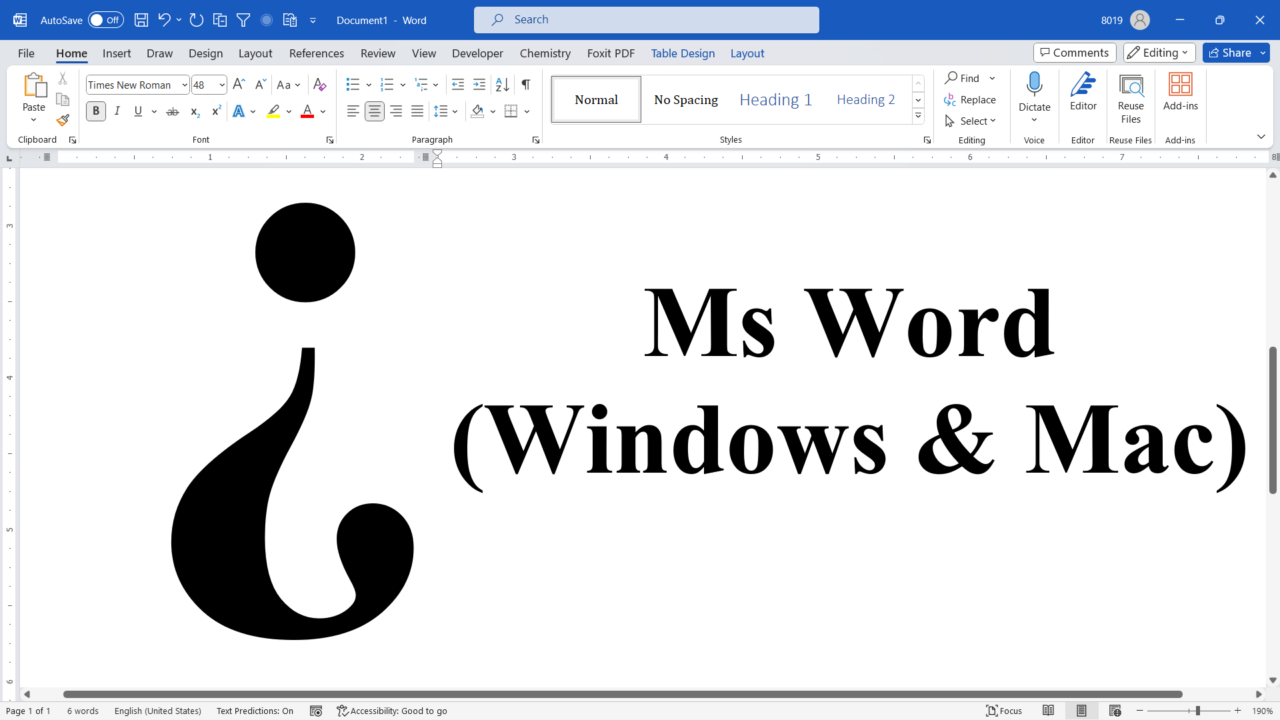
Quick answer: To type the inverted question mark ¿ in Word for Windows, enter 00BF and press Alt+X, or hold Alt and type 0191 on the numeric keypad. On a Mac, try Option+Shift+? with a US keyboard layout. This punctuation mark opens a question in Spanish; the ordinary question mark closes it.
Choose the method that matches your device: Unicode conversion and the numeric-keypad Alt code are Windows desktop options; the macOS shortcut depends on keyboard layout. The symbol is Unicode U+00BF, so it can also be copied directly: ¿.
- Insert Symbol (Windows)
- Alt Code (Windows)
- Character Map (Windows)
- Keyboard shortcuts and Unicode (Windows & Mac)
- Custom keyboard shortcut (Windows)
- Word 365 search bar (Windows & Mac)
1. Insert the Symbol in Word for Windows
- Go to the ‘Insert’ Tab > ‘Symbol’ in the ‘Symbols’ group and select ‘More Symbols’.

- Select ‘Latin-1 Supplement’ from the ‘Subset’ drop-down list in ‘Symbol’ dialog box.
- Scroll down the list of symbols until you find the ¿, and then click on it.

- Click on the ‘Insert’ button to insert the ¿ into your document.


2. Use the Numeric-Keypad Alt Code
This numeric-keypad method is intended for Word on Windows. It requires a numeric keypad or an equivalent embedded numpad; it is not the standard method on macOS.
- Press and hold the ‘Alt’ key on your keyboard.
- While holding the ‘Alt’ key, type 0191 (the Alt code for the inverted question mark) using the numeric keypad.
- Release the ‘Alt’ key, and the upside down question mark symbol will appear in your Ms Word document.
3. Use Windows Character Map
- Open the ‘Character Map’ utility by searching for it in the Windows Start menu.
- In Character Map, choose a font that contains the character, such as Arial.
- Find and select ¿ in the character grid. If you use Character Map’s advanced search, enable Advanced view first; search controls can vary by Windows version.

- Click on the ‘Copy’ button to copy the symbol.
- Switch back to your Word document and paste the inverted/upside down question mark.

4. Use Unicode on Windows or the Mac Keyboard
For more general shortcuts, consult Microsoft’s Word keyboard reference. The following symbol-entry methods depend on your operating system and keyboard layout.
Word for Windows: Type 00BF, then press Alt+X to convert the Unicode code into ¿. You can also use the numeric-keypad Alt+0191 method above. Keyboard shortcuts tied to a particular layout may differ.
Word for Mac: On a US keyboard layout, use Option+Shift+? (often shown as Option+Shift+/ because ? is on the slash key). If your keyboard layout differs, use Edit → Emoji & Symbols to find the inverted question mark.
5. Assign a Custom Shortcut in Word for Windows
If you type ¿ frequently, desktop Word for Windows lets you assign a custom shortcut. Check the existing key assignment before replacing it, and choose a combination that does not conflict with a command you use.
- Go to ‘Insert’ Tab > ‘Symbol’ and click ‘More Symbols’
- Select ‘Latin-1 Supplement’ from the ‘Subset’
- Select ¿ (inverted question mark symbol) and click Shortcut Key (if available) to open the Customize Keyboard dialog.

- Place your cursor in “Press new shortcut key:” and hit the desired shortcut key combination that you want assign to get inverted question mark.

- Click “Assign”


6. Search for the Command in Microsoft 365 Word
The Microsoft 365 Search box primarily locates commands and help; it is not a reliable symbol picker. Some older versions or configurations may show a direct inverted-question-mark suggestion, as illustrated below. If no such suggestion appears, use Insert > Symbol > More Symbols or the Unicode method instead.
- To insert symbol, type “inverted question mark” in Word 365 search bar.

- Only if a matching symbol-insertion suggestion appears, select it. Otherwise, return to Insert > Symbol; do not assume every Microsoft 365 build supports this search result.

Example: Type a Spanish Question Correctly
Spanish uses an opening inverted question mark and a closing standard question mark: ¿Cómo estás? Type or insert ¿ at the start of the question and ? at the end. The opening character is U+00BF, while the closing question mark is U+003F. If you see a replacement square, check that the selected font supports Latin-1 characters.
Troubleshooting the Inverted Question Mark
- Alt+0191 does nothing: Use the numeric keypad with Num Lock enabled, or try the Unicode Alt+X method.
- The Mac shortcut produces a different character: Check your keyboard layout and use the macOS Character Viewer.
- Word’s search box cannot find the symbol: Use Insert → Symbol → More Symbols and select Unicode U+00BF.
Summary
For a one-off symbol, copying ¿ or using Insert → Symbol is convenient. If you type Spanish regularly, consider adding a Spanish keyboard layout. For Windows Word, 00BF followed by Alt+X is a reliable alternative to a numeric keypad.
Related guides: How to Type Accents in Word: Keyboard Shortcuts for é, ñ, ü and More · Degree Symbol (°) in Word: Windows and Mac Shortcuts · Insert a Check Mark or Checked Box in Word (✓, ✔, ☑)

C P Gupta is a YouTuber and Blogger. He is expert in Microsoft Word, Excel and PowerPoint. His YouTube channel @pickupbrain is very popular and has crossed 9.9 Million Views.
Pingback: (¿) Upside down question mark shortcut for Ms Word [2024] - Wisdomiseme