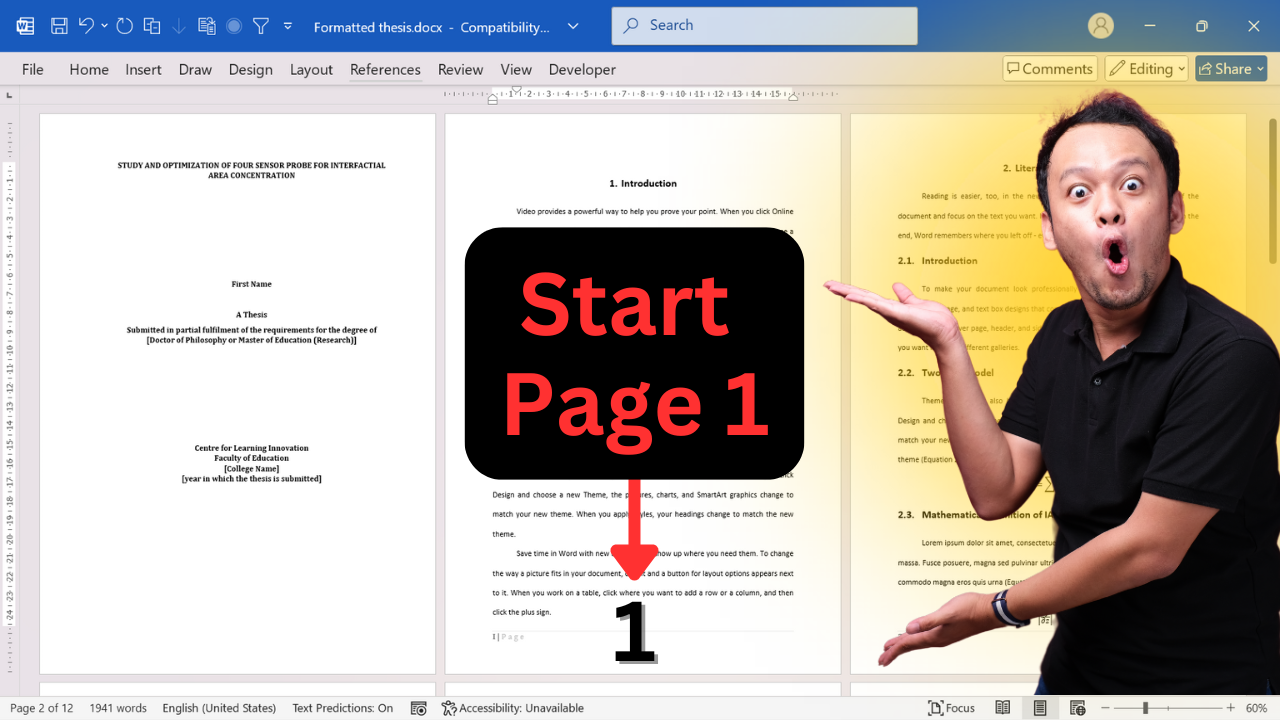
Quick decision: page 2 displays 1 or 2?
If you want the cover page unnumbered but the second page to display 2, insert page numbers and enable Different First Page; leave numbering starting at 1. If you want the second page to display 1, set Format Page Numbers > Start at 0. This is a numbering-format setting, not a second section. Use section breaks only when the cover page needs independent headers, footers or more complex numbering.
Best for most reports: use Different First Page without inserting a section break. Choose whether the second physical page should display 1 or 2 before changing the numbering format. These steps apply primarily to desktop Word; the web version may not expose all section and numbering controls.
Why Start Page Numbering from the Second Page?
Many reports, theses, and proposals leave the cover page unnumbered. The second physical page may show 1 or 2, depending on your institution’s formatting requirements. The methods below handle both cases without changing the document’s physical page order.
Method 1: Using “Different First Page” (For Simple Documents)
- Insert Page Numbers:
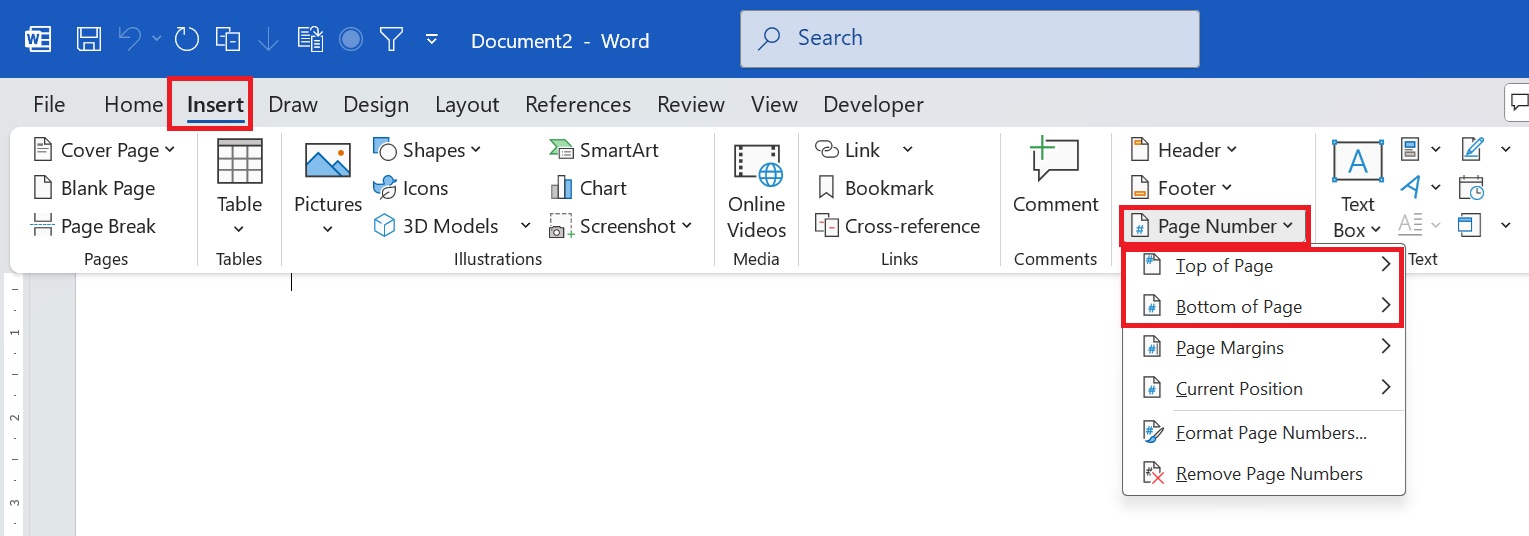
- Click Insert > Page Number
- Choose a location (Top, Bottom, etc.)

- Enable Different First Page:
- Double-click the header or footer to open the Header & Footer Design tab
- Check Different First Page
- For a single-section document, Link to Previous is irrelevant because there is no preceding section. Use Different First Page to hide the cover-page number.

- Adjust Page Numbering:
- With the header or footer open, use Page Number > Format Page Numbers. You do not need to select the second page for a single-section document.
- Confirm the Format Page Numbers dialog is open; the screenshot below shows the command location.

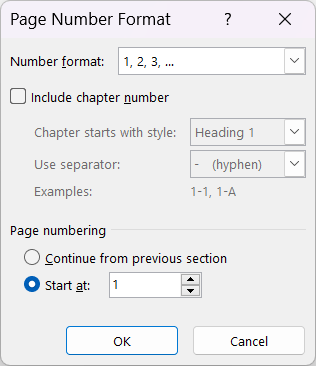
- For the second physical page to display 1, choose Start at: 0. To display 2, keep the default numbering starting at 1.

- Click OK
- Remove First Page Number:
- Click anywhere on first page (where you don’t want page number)
- The Different First Page option normally hides the regular header/footer number on the cover automatically. Only if a number remains in the First Page Header/Footer, remove that number there; leave the regular header/footer number intact


Check the result: The cover should have no visible number. Page 2 shows 1 only if you selected Start at 0; otherwise it shows 2. Scroll to page 3 to confirm that numbering continues correctly.
Video Demonstration
Method 2: Using Section Breaks (For Complex Documents)
If your document contains a cover page and table of contents, you may need section breaks to handle numbering correctly.
- Insert a Section Break:
- Place the cursor at the end of Page 1
- Click Layout > Breaks > Next Page (From Section Break)

- Unlink Sections :
- Double-click the footer on Page 2
- Click Link to Previous to turn it OFF

- Insert Page Numbers in Section 2:
- Click Insert > Page Number
- Select Format Page Numbers
- Set Start at: 1

- Delete Page Number on First Page (If Needed):
- In Section 1, delete the number from Page 1


🚀 This method is useful if you want different numbering styles (e.g., Roman numerals for TOC and Arabic numerals for content).
Troubleshooting & FAQs
Q1: Page numbering doesn’t start from 1 on the second page.
🔹 Solution: Ensure “Start at 0” is selected in Page Number Format settings while using Method 1.
Q2: Page numbers appear on the first page even after “Different First Page” is enabled.
🔹 Solution: First check whether the number is in the First Page Header/Footer or is ordinary text. Remove only the first-page field if present. In a multi-section document, inspect each section’s Different First Page and Link to Previous settings before unlinking anything.
Q3: How do I start numbering from the third page instead?
🔹 Solution: For page 3 to display 1, place a Next Page section break at the end of page 2, unlink the section 2 footer from the previous section, and start section 2 numbering at 1. See the dedicated page-3 numbering guide. A section break after page 1 alone does not accomplish this.
Worked example: a four-page report with an unnumbered cover
Suppose a report has a cover, introduction, methods and conclusion. With Different First Page enabled and numbering set to Start at 0, the visible footer sequence is blank, 1, 2, 3. With numbering starting at 1, it is blank, 2, 3, 4. If the cover must have a separate header design or the introduction starts after a multi-page contents section, use section breaks instead of relying on Different First Page alone.
Check the actual PAGE field: click the footer on page 2 and confirm the numeral is an automatic page-number field, not manually typed text. Insert a temporary page before the conclusion and verify that subsequent page numbers update; then undo the test. This catches a common mistake that a static numeral cannot reveal.
Final checks before exporting to PDF
Inspect the first three pages in Print Preview: the cover should be blank, the second page should show the number required by your style guide, and the third should follow sequentially. Export to PDF and check those pages again. If the cover still has a number, open its First Page Header/Footer and remove only that field—not the regular footer used on later pages. In documents with section breaks, check each section separately.
Avoid common section-break and numbering mistakes
For a simple two-page cover-and-body layout, start with Different First Page; a section break is usually unnecessary. When you genuinely need separate sections, turn on formatting marks (Home > ¶) to see where the section break is. A Next Page section break can add an unwanted blank page if a manual page break already exists there. Remove only the redundant break after inspecting the layout.
Important: Word’s Link to Previous controls are separate for headers and footers, and may also differ for first-page and odd/even-page headers. Unlink only the part you need before deleting a page-number field. Deleting a linked footer number can otherwise remove it from earlier sections too. Page numbers inserted as a PAGE field follow section numbering settings; typing the numeral “1” manually does not create automatic numbering.
Accessibility and document delivery checklist
- Use Word’s automatic Page Number command rather than typing numerals into footers; automatic fields stay accurate when pages are added.
- Check that page-number text has readable contrast and does not overlap body text, images or footer content.
- After exporting to PDF, compare physical PDF page order with the page labels printed in the document. PDF viewer page indexes and printed page numbers can differ.
- If a table of contents or cross-references display page numbers, update the fields and verify their destinations before sharing.
For a more complex document that begins numbering on its third physical page, follow the page-three numbering guide. Microsoft also provides guidance for starting numbering later in a document.

C P Gupta is a YouTuber and Blogger. He is expert in Microsoft Word, Excel and PowerPoint. His YouTube channel @pickupbrain is very popular and has crossed 9.9 Million Views.
Hi
Please help. I am using Roman numbering but have disabled i on first page but want it (i) to show starting from page 2. It keeps showing (ii). What am I missing?
Thanks
Zo
Thanks for the comment.
I tried to reproduce your problem.
Different first page didn’t work as in that case, we need to start at 0 (which could not be set in my version of Ms Word (Office 365))
Hence I suggest to go with 2nd method shown in Blog.
Please let me know if it worked.
Thanks & Regards
Pickupbrain
hi
Hi