Introduction
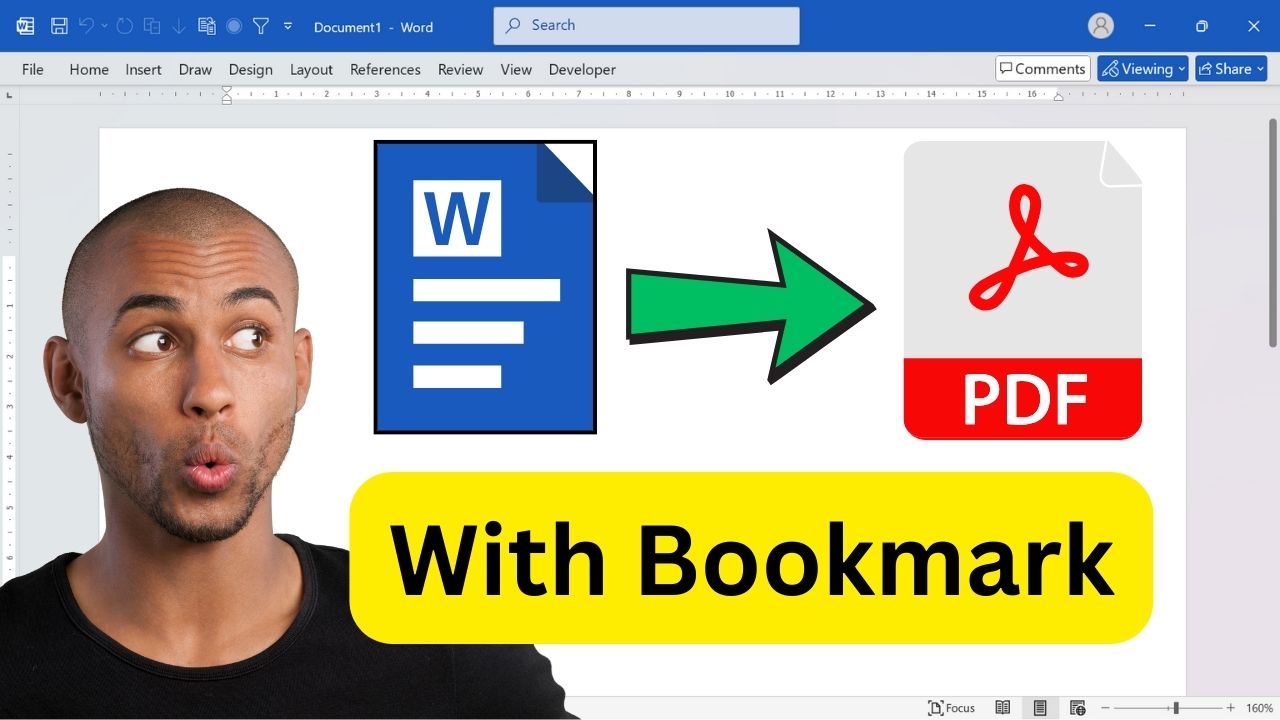
To export a Microsoft Word document as a PDF with working hyperlinks and navigation bookmarks, use Word’s built-in PDF export rather than printing to PDF. The available bookmark options depend on your version of Word and how you formatted the document headings. Follow these steps to preserve navigation and verify the exported file.
Method 1: Using Microsoft Word’s Built-in Save As PDF Feature
The easiest way to create a PDF with working bookmarks and hyperlinks is by using Word’s built-in options.
Steps for Windows:
- Prepare the Document: Ensure headings are formatted with Heading Styles (H1, H2, H3, etc.) as these are automatically converted into bookmarks.
- Check Hyperlinks: Use
Ctrl + Clickto verify that hyperlinks work correctly. - Save as PDF:
- Click on File > Save As.
- Choose PDF (*.pdf) from the “Save as type” dropdown.
- Click Options

- Make sure “Create bookmarks using: Headings and/or Work bookmarks” is selected.

- Ensure “Document structure tags for accessibility” is checked.
- Click Save.


Steps for Mac:
- Follow Steps 1 & 2 from Windows.
- Click File > Save As.
- Select PDF as the format.
- Click Best for electronic distribution and accessibility (to ensure bookmarks are included).
- Click Export.
Method 2: Using “Print to PDF” (Does NOT Preserve Bookmarks)
While you can use “Print to PDF” in Word:
- It does NOT preserve bookmarks.
- Hyperlinks might remain clickable but are sometimes lost.
- Recommended only if formatting issues arise using “Save As”.
Method 3: Using Adobe Acrobat to Convert Word to PDF (Advanced Features)
If you have Adobe Acrobat Pro, it offers better control over bookmark preservation.
Steps:
- Open your Word document.
- Click Acrobat > Create PDF.
- Under Preferences, ensure “Add Bookmarks” and “Add Links” are checked.
- Click Save.
Method 4: Using Online Converters (Caution!)
Many online tools like Smallpdf, iLovePDF, and PDF2Go can convert Word to PDF, but:
- Some strip bookmarks and hyperlinks.
- Privacy risks (avoid for sensitive documents).
- Formatting inconsistencies may occur.
Common Issues & Fixes
1. Hyperlinks Not Working in PDF
- Ensure hyperlinks are properly formatted (i.e.,
https://for external links). - Recheck document before converting.
2. Bookmarks Missing
- Use Heading Styles instead of manual text formatting.
- Ensure “Create Bookmarks using Headings” is enabled in Save As PDF options.
3. Broken Formatting After Conversion
- Use Adobe Acrobat for a better conversion experience.
- Avoid “Print to PDF” method if you need bookmarks.
Alternative Tools for Better Conversion
| Tool | Bookmark Support | Hyperlink Support | Best For |
|---|---|---|---|
| Adobe Acrobat Pro | ✅ | ✅ | Professional PDFs |
| Microsoft Word Save As PDF | ✅ | ✅ | Most users |
| Smallpdf/iLovePDF | ❌ | ✅ | Quick conversion |
| PDFelement | ✅ | ✅ | Advanced customization |
FAQs
1. Can I edit bookmarks in the PDF after conversion?
Yes, tools like Adobe Acrobat Pro and PDFelement allow editing bookmarks in PDFs.
2. How do I test if bookmarks work?
Open the PDF in Adobe Acrobat Reader and check the Bookmarks Panel (View > Show/Hide > Navigation Pane > Bookmarks).
3. What if my hyperlinks work in Word but not in the PDF?
Try enabling Document structure tags for accessibility in Save As PDF settings.
4. Can I batch convert multiple Word files while keeping bookmarks?
Yes, Adobe Acrobat Pro allows batch conversion while retaining bookmarks.
Conclusion
Preserving bookmarks and hyperlinks in PDFs is essential for creating a well-structured and navigable document. Using the correct Microsoft Word settings or advanced PDF tools, you can ensure seamless document navigation. If you need professional-level customization, tools like Adobe Acrobat Pro or PDFelement are recommended.
Related Posts

C P Gupta is a YouTuber and Blogger. He is expert in Microsoft Word, Excel and PowerPoint. His YouTube channel @pickupbrain is very popular and has crossed 9.9 Million Views.