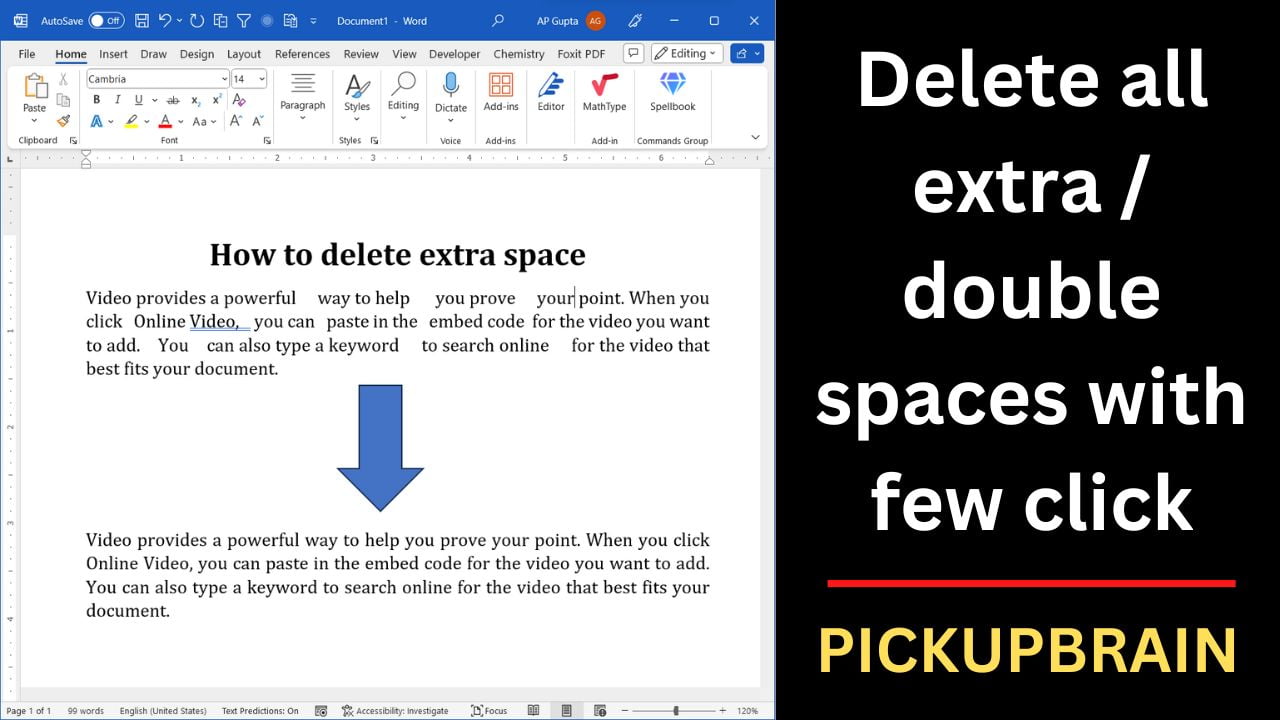
Remove Double or Multiple Spaces in Microsoft Word
Quick answer: In desktop Microsoft Word, press Ctrl+H, enter two ordinary spaces in Find what and one space in Replace with, then choose Replace All. Repeat until Word reports no more replacements. For runs of two or more spaces in one pass, use Word’s wildcard search described below. Save a copy first if your document uses intentional spacing.
Extra spaces often appear after copying text from websites or combining documents. The methods below target repeated ordinary spaces between words; they do not automatically remove tabs, nonbreaking spaces, or paragraph marks.
Method 1: Remove Multiple Spaces with Word Wildcards
Word’s wildcard search can match two or more consecutive spaces and replace each run with one ordinary space. Unlike standard regular expressions, Word uses its own wildcard syntax.
- Press ‘Ctrl + H’ to open the ‘Find and Replace’ dialog box.
- Choose More >> to reveal additional search options, if necessary.
- Select the Use wildcards check box.
- In the ‘Find what’ field, type ‘( ){2,}‘ without quotes. Note there is only space between ( ) brackets. FYI: This is a Word wildcard pattern that matches two or more ordinary spaces.
- In Replace with, enter one ordinary space. This avoids needing a backreference and replaces every matched run with one space.
- Choose Replace All, then inspect the affected text. If the document contains intentional spacing, use Find Next and Replace selectively instead.
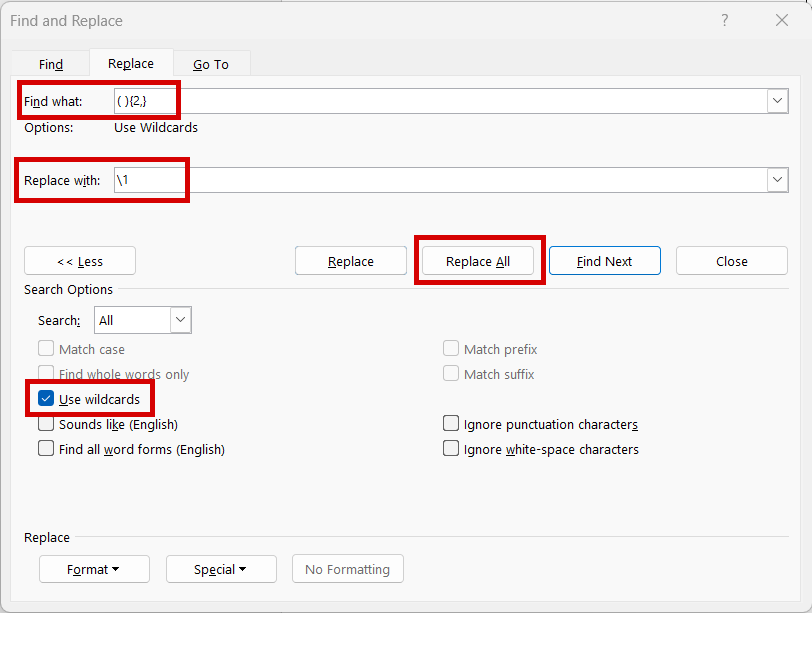
Review the replacement count and inspect a few affected paragraphs. If your document includes alignment created with spaces, those areas may also change; tabs or a properly formatted table are usually more reliable for alignment.
Method 2: Replace Double Spaces Without Wildcards
For a simpler method, open Ctrl+H, turn Use wildcards off, type two spaces in Find what and one space in Replace with. Choose Replace All and repeat until no double spaces remain. This method is easy to check, although runs of three or more spaces can require several passes.
Troubleshooting: Spaces Still Remain
- Show formatting marks: Press Ctrl+Shift+8 on Windows to display spaces as dots and tabs as arrows. This helps identify what is actually between words.
- Check for nonbreaking spaces: In Find and Replace,
^srepresents a nonbreaking space in Word’s standard search. Handle these separately when appropriate. - Check for tabs: Tabs are not ordinary spaces. In standard Find and Replace,
^tsearches for tab characters. - Preserve deliberate formatting: Avoid global replacement in code samples, aligned text, or documents that use spaces intentionally. Use Find Next and Replace for selective changes.
Tip: Use Word’s paragraph spacing and indentation controls instead of inserting multiple spaces to position text. If you are cleaning a large document, keep a backup and inspect the result before sharing it.
Worked example: clean spaces without changing the words
Suppose a draft contains Project budget approved (two spaces after “Project” and four after “budget”). With Use wildcards selected, search for ( ){2,} and replace with a single space. The result is Project budget approved. The replacement changes runs of ordinary spaces; it does not rewrite the words or punctuation.
Test the method first on a small copied paragraph, then inspect the full document after replacing. If the document contains preformatted code, indentation, forms or manually aligned columns, select only the ordinary prose before using Replace All.
Frequently asked questions
Why did Replace All not remove every visible gap? Some gaps are tabs, nonbreaking spaces, paragraph spacing or table-cell padding rather than repeated ordinary spaces. Show formatting marks and identify the actual cause before changing it.
Does this also work in Word for the web? Word’s advanced wildcard options are desktop features; availability and controls vary across Word versions. If the web editor does not expose the required option, open the document in desktop Word or use ordinary two-space replacement where supported.
Can I undo an unwanted replacement? Immediately use Undo if available, or restore the saved backup. Review formatting after a large replacement before saving over the original.
Related guides
To inspect search matches individually, see Find Next in Microsoft Word. For displaying hidden spacing characters, see paragraph marks and formatting symbols.
Related Posts

C P Gupta is a YouTuber and Blogger. He is expert in Microsoft Word, Excel and PowerPoint. His YouTube channel @pickupbrain is very popular and has crossed 9.9 Million Views.