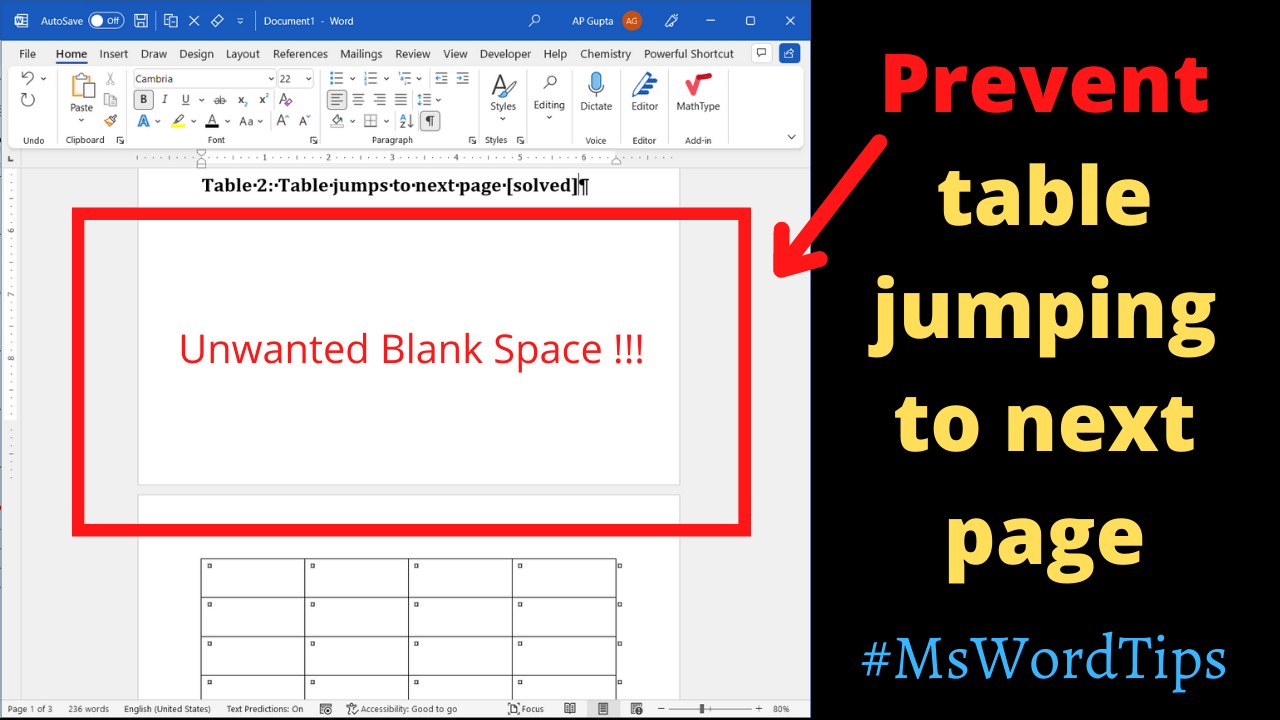
If a Microsoft Word table jumps to the next page despite apparent space above it, inspect paragraph pagination settings, repeated header rows, table wrapping and row-splitting rules. The cause is often a paragraph’s Keep with next or Page break before setting rather than an actual page break.
Why a Word table may start on the next page
A table can start on the following page even when the preceding page has visible space and no manual page break. In this example, the table’s paragraph and positioning settings—not empty lines—are the first things to investigate.

Four Word table pagination settings to check
1. Floating tables: check Move with text
Important: Move with text is a positioning option for floating tables (Text wrapping: Around), not ordinary inline tables. If you do not need text to wrap around the table, use Table Properties > Table > Text wrapping: None instead.
- Click inside the table, then choose Table Layout > Properties (the contextual tab may be labelled Layout).
- On the Table tab, confirm that Text wrapping is set to Around before choosing Positioning. Inline tables with wrapping set to None do not have this floating-table positioning option.

- If the table must remain floating, enable Move with text, then select OK to close the dialogs. If floating placement is unnecessary, choose Text wrapping: None instead.
If the table still starts on the next page, undo any ineffective change and inspect the paragraph pagination settings below.
2. Check which rows repeat as headers
Repeating header rows is useful when a long table spans pages. It is not usually the cause of a table moving to a new page. Inspect this option if too many rows were accidentally marked as headers; select only consecutive header rows at the top of the table.
Solution: Turn off repeat header rows
- Click in a row that is currently designated as a repeated header.
- On Table Layout, toggle Repeat Header Rows off only if that row is not a genuine header. Do not remove meaningful header designation just to change pagination.

If this solves the problem, you can again setup table to repeat header rows using the following steps
Correct way to Repeat Header Rows
- Select only the table rows you want to repeat when table extends to next page
- Go to Layout tab and select “Repeat Header Rows”
If problems persists, try the remaining methods
3. Check Page break before on the first table paragraph
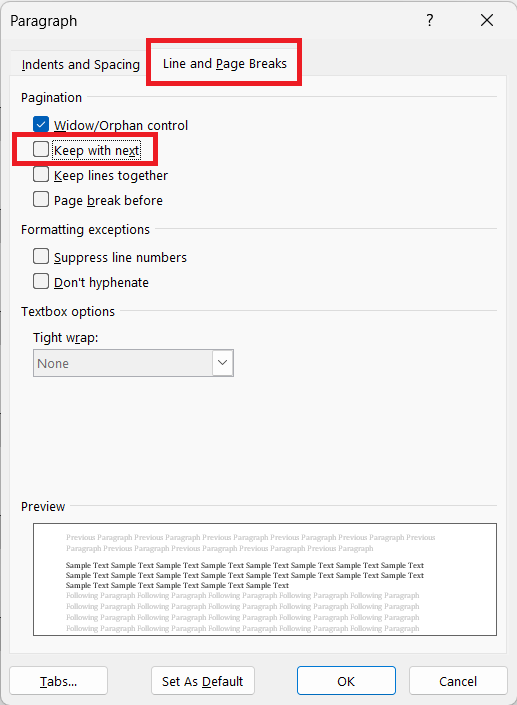
Word’s Page break before paragraph property forces a paragraph to start on a new page without inserting a separate manual page-break character. That is why showing formatting marks may not reveal an obvious break. Check the first cell’s paragraph and the paragraph immediately before the table before changing the whole table.
Solution: Remove “Page break before” setting
- Place the insertion point in the first table cell, or select only the paragraphs you want to inspect.
- On the Home tab, open the Paragraph dialog launcher.

- Go to “Line and Page Breaks” tab of Paragraph window
- Uncheck the box against “Page break before” and click ok

If the table still moves, inspect Keep with next in the following section.
4. Check Keep with next on the heading and table cells
Solution: Turn off “keep with next” option for table
- Inspect the paragraph directly before the table and the paragraphs in its first rows.
- Open Home > Paragraph > Line and Page Breaks.
- Clear Keep with next only on paragraphs whose linking is unintended; preserve it on a heading that should remain with the table. Select OK and check pagination again.
Video showing all four solutions
Conclusion
Choose the fix that matches the cause. Do not disable every pagination setting: Keep with next may be useful for a heading, and repeated header rows help readers follow a long table.
- Enable “move with text” option
- Correct use of “Repeat row header”
- Turning off “Page break before” setting
- Turning off “keep with next” setting
For a repeatable test, make a copy of the document, insert a three-row table after a heading near the bottom of a page, and compare the result with Keep with next enabled and disabled on the heading and first-row paragraphs. Check Print Layout and the exported PDF before deciding which setting to keep.
Check the paragraph before the table
Turn on formatting marks using Home > ¶. Select the paragraph immediately before the table and open Paragraph > Line and Page Breaks. Clear Page break before or Keep with next only if those settings are unintended. Do not remove intentional section breaks.
Check row and table settings
Select the table and open Table Properties > Row. Allow row to break across pages controls whether a tall row can split; disabling it can force the entire row onto the next page. For floating tables, Table Properties > Table > Text wrapping and Positioning affect placement.
Keep the heading with the table
If you want a heading to stay above a table, Keep with next on the heading can be helpful. But if many consecutive table paragraphs are also set to Keep with next, Word may move a large block to the next page. Inspect the settings selectively rather than disabling pagination rules everywhere.
Quick diagnosis: which setting is responsible?
- First row starts on a new page: check the preceding heading and first table-cell paragraph for Page break before and Keep with next.
- One tall row moves: open Table Properties > Row and check Allow row to break across pages. When disabled, Word may move the whole row.
- Table floats or overlaps text: inspect Table Properties > Table > Text wrapping. Move with text applies to floating tables only.
- Several rows move together: Keep with next may be enabled on multiple consecutive table paragraphs. Clear it selectively.
- Still unresolved: show formatting marks (Home > ¶) and inspect section breaks and page margins before changing the document structure.
Accessibility: retain genuine header rows when a table spans pages, and avoid inserting blank paragraphs or manual page breaks merely to force the layout. Test on a copy of the document, particularly when it contains merged cells.
Related guides: Text Jumping to the Next Page in Word: Pagination Fixes · How to Keep a Table on One Page in Microsoft Word · How to Fix a Word Table That Extends Beyond Page Margins

C P Gupta is a YouTuber and Blogger. He is expert in Microsoft Word, Excel and PowerPoint. His YouTube channel @pickupbrain is very popular and has crossed 9.9 Million Views.
GREAT THANK you it’s really help
Welcome dear. Glad to know it helped.