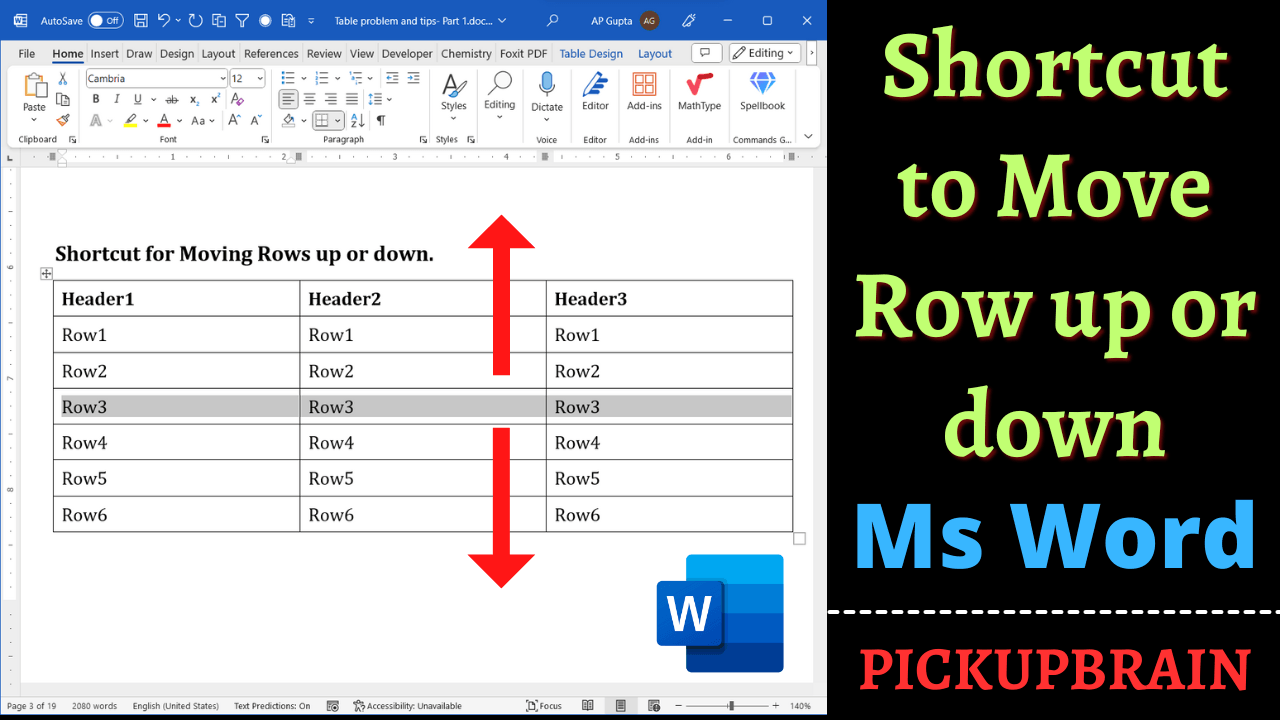
Quick answer: In desktop Microsoft Word for Windows, place the cursor in a table row and press Alt+Shift+Up Arrow or Alt+Shift+Down Arrow to move that row. You can also select several adjacent rows and move them together. This guide covers the shortcut, examples, and common reasons it might not work.
How to move a Word table row with the keyboard
These shortcuts reorder simple table rows without manually cutting and pasting cell contents. Save the document before reorganizing a complex table.
Steps
- Click inside the row you want to move. To move several rows as a group, select the adjacent rows first.
- Press the appropriate shortcut below. Check the new position and repeat if needed.
| To do this | Shortcut in desktop Word for Windows |
|---|---|
| Move table row up | Alt+Shift+Up Arrow |
| Move table row down | Alt+Shift+Down Arrow |
Note
The instructions here are intended for desktop Word on Windows. Word for Mac and Word for the web can have different keyboard behavior. Keyboard shortcuts may also be intercepted by system utilities or accessibility tools.
The shortcut moves the row’s contents and cells together. When a row reaches a table boundary, the behavior can depend on the table structure and Word version. Verify the result, especially in tables with merged cells or nested tables.
Outside tables, the same shortcut can move a paragraph up or down in desktop Word. For multi-paragraph selections, test the behavior on a copy before rearranging a long document.
Example: Move a Row in a Three-Row Table
Imagine a table whose rows are Draft, Approved, and In Review. Click inside the In Review row and press Alt+Shift+Up Arrow. The intended order becomes Draft, In Review, Approved. If the table has merged cells or a repeating header row, check the result before making further changes.
Verification checklist for a moved row
In a copy of a simple three-row table, label the rows A, B, and C. Put the insertion point in row C and press Alt+Shift+Up Arrow. Confirm that the new order is A, C, B; check that all cell contents remain in their original columns. Undo with Ctrl+Z if the result is unexpected. For tables with merged cells, repeating header rows, formulas, or nested tables, check the entire table after each move rather than assuming all structure is preserved.
Troubleshooting: Shortcut Not Working
Nothing happens: Confirm that the insertion point is inside the table and that you are using desktop Word for Windows. Another application responds: A system-wide shortcut may be taking precedence. Unexpected table formatting: Merged or nested cells can complicate row movement; save a copy before rearranging complex tables. Word for the web: The desktop shortcut may not be supported in the browser.
Related Word table tutorials
For additional table editing guidance, see how to merge two tables in Microsoft Word.
Frequently asked questions
Can I move multiple rows at once? Select adjacent complete rows, then try Alt+Shift+Up Arrow or Alt+Shift+Down Arrow. Check the result carefully when merged cells or repeating header rows are present.
Why did the shortcut move a paragraph instead? Word also uses these shortcuts for paragraphs. Make sure the cursor is in the intended table row and that you have not selected text outside the table.
What if the shortcut does not work on my Mac or in Word for the web? Shortcut support differs by platform. Select the row and use desktop Word’s cut-and-paste tools, then check cell formatting and table structure.
Accessibility after rearranging table rows
Check that the table still has meaningful column headers, a logical reading order, and no blank cells used solely for spacing. In desktop Word, use Review > Check Accessibility where available. If the first row is a header, verify the Repeat Header Rows setting after rearranging the table, especially when it spans pages.
Video
Summary
Moving rows with the keyboard can be faster than cutting and pasting, especially in simple tables. For complex tables, inspect merged cells, formulas, and formatting after reordering.
If the shortcut does not behave as expected, use Word’s table selection commands and move the row carefully with Cut and Paste instead.
You may also like

C P Gupta is a YouTuber and Blogger. He is expert in Microsoft Word, Excel and PowerPoint. His YouTube channel @pickupbrain is very popular and has crossed 9.9 Million Views.