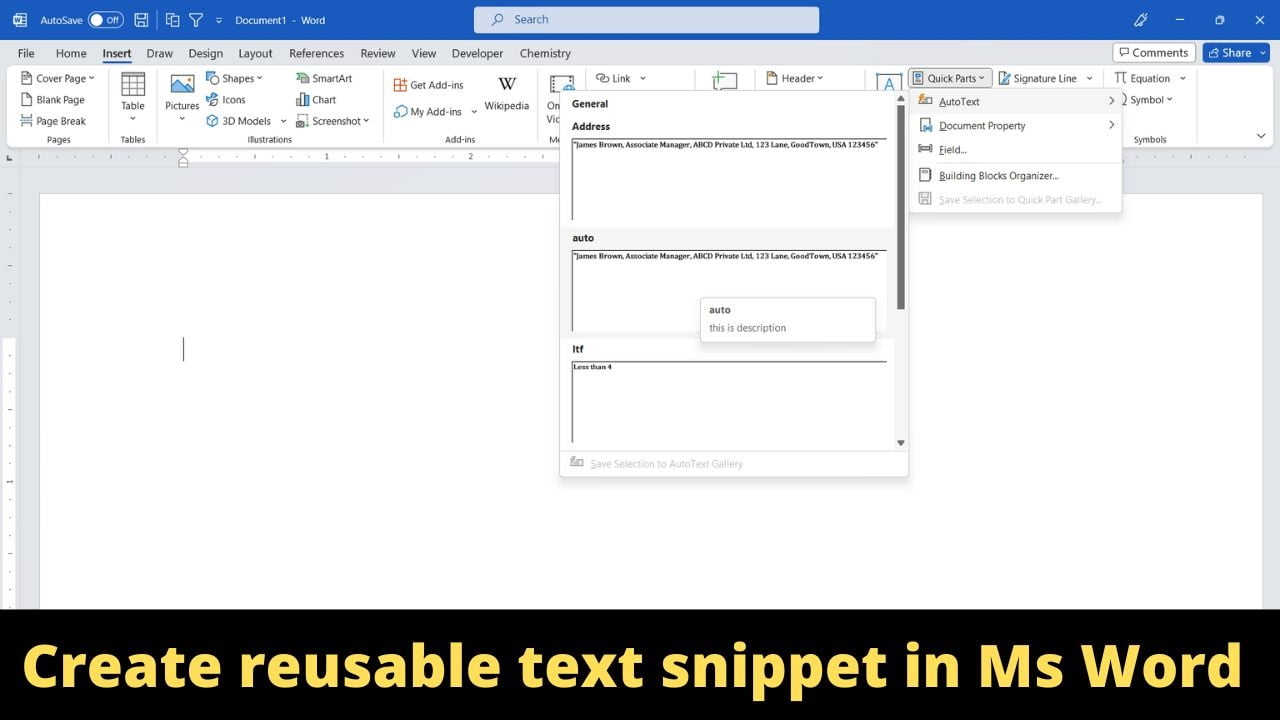
AutoText lets you save reusable text and formatting as a building block in desktop Microsoft Word. This guide explains how to create an entry, insert it repeatedly, and troubleshoot templates and differences between Windows and Mac.
For example, save the following contact block as an AutoText entry named Address so you can reuse it in future documents.
“James Brown, Associate Manager, ABCD Private Ltd, 123 Lane, GoodTown, USA 123456”
How to create an AutoText entry in Word for Windows
- Select the text for which you want to create AutoText entry.
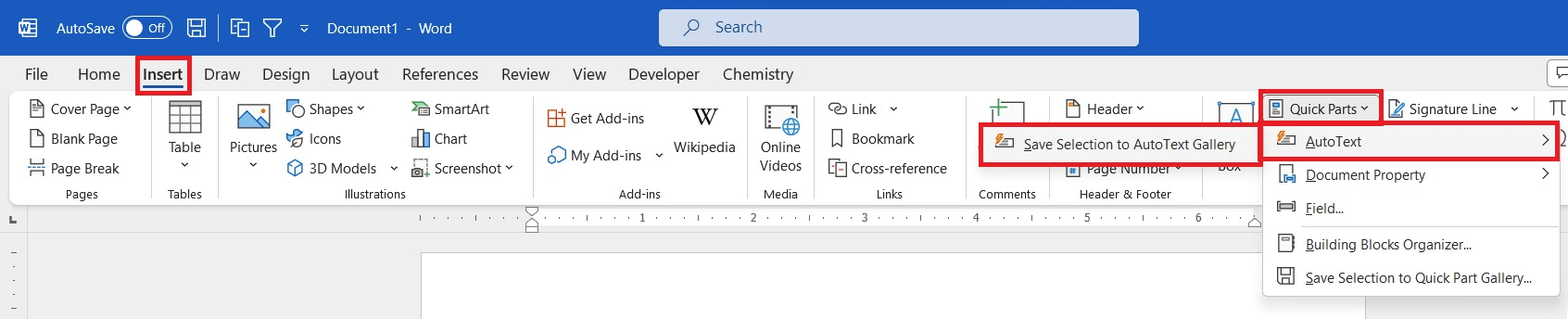
- Go to Insert > Quick Parts > AutoText > Save Selection to AutoText Gallery. On Word for Windows, you can also use the keyboard shortcut Alt+F3.

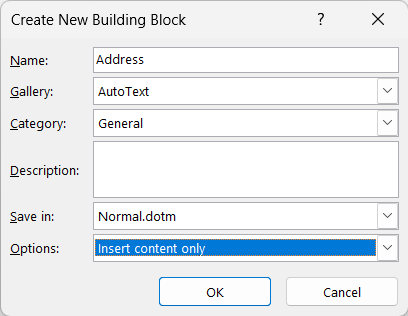
- In “Create New Building Block” window set the following field
- Name: Type any name. To use auto complete feature for inserting text snippet (one of the fastest way to insert auto text), use a distinctive name such as Address; autocomplete suggestions are not guaranteed in every Word version.
- Gallery: AutoText
- Category: You can use General or you can create your own category. This helps in organizing Auto Text entry.
- Description: This is optional.
- Save in: Choose a template available wherever you need the entry. Normal.dotm is typically available in your Word profile; Building Blocks.dotx is another option. AutoText entries do not necessarily sync between computers. To share them, transfer an appropriate template using your organization’s approved process.
- Options: Select suitable option among “Insert content only”, Insert contents in its own paragraph” or “Insert contents in its own page” as per your needs.

- Click OK.
Four ways to insert saved AutoText
Once you create an AutoText entry, insert it using one of these methods in supported desktop versions of Word.
Method 1: Choose the entry from the AutoText gallery
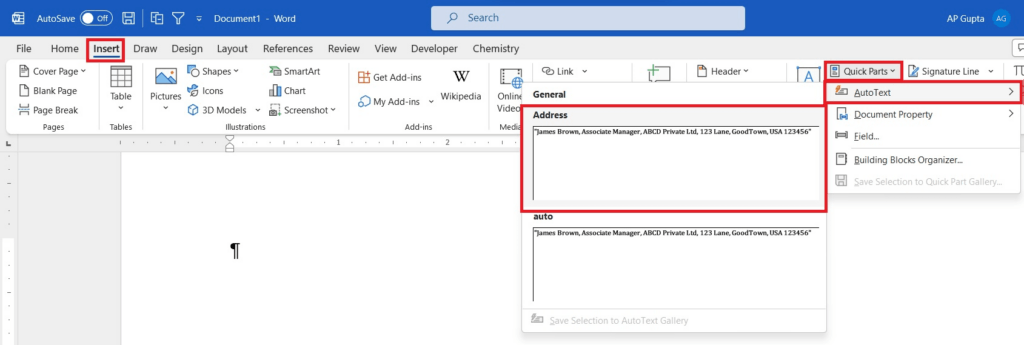
Go to Insert > Quick Parts > AutoText and click on desired Auto Text entry to insert it as shown below. For each auto text, Name and auto text snippet are shown in the list.
Method 2: F3 keyboard shortcut
Type complete name of Auto text (you have set while creating auto text entry), and hit F3 immediately after it.
Method 3: Accept an AutoComplete suggestion, if offered
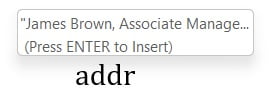
In some desktop Word versions, typing the beginning of an AutoText entry name displays a completion suggestion. If the correct suggestion appears, press Enter. The screenshot shows an entry named Address. Do not rely on a prompt after exactly four characters.
Tip: If no suggestion appears, type the full saved name and try F3, or use the AutoText gallery.
Method 4: Building Blocks
Go to Insert > Quick Parts > Building Blocks Organizer. In the organizer, find your saved AutoText entry, select it and choose Insert.
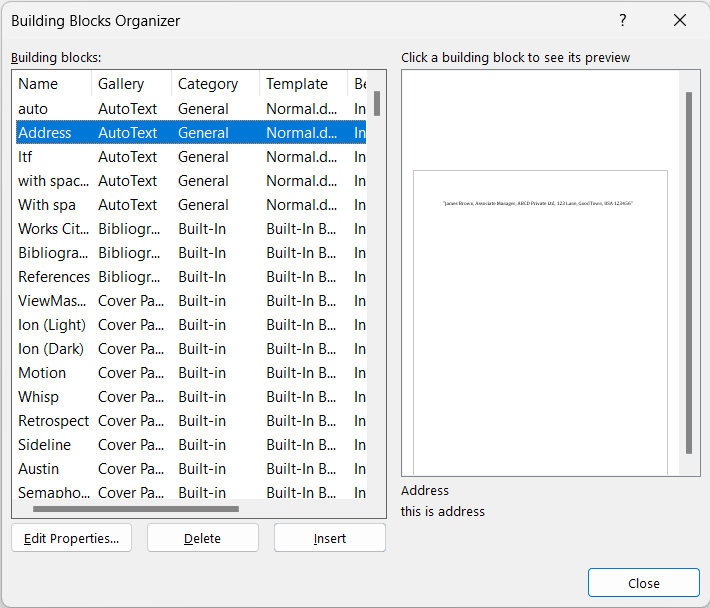
This method also gives the option to edit and delete auto text entry.
Points to know about Auto Text
- AutoText names are generally matched without regard to capitalization when using F3; if insertion fails, check the spelling and whether the entry is available in the active template.
- Auto text doesn’t limit you to save only text snippet. An AutoText entry can include formatted paragraphs, tables, and images, not just plain text.
Where Word stores AutoText entries
AutoText entries are building blocks saved in a template. Availability across documents and computers depends on which template you selected and whether that template is available. When Word asks to save changes to a template on exit, review the prompt carefully so your new entry is retained.
AutoText versus AutoCorrect
Use AutoText for paragraphs, addresses, disclaimers and other formatted blocks that you intentionally insert. Use AutoCorrect for short text substitutions that should expand as you type. On Word for Mac, building-block menus and keyboard options may differ; if Quick Parts is unavailable, check Insert > AutoText or the app’s available templates.
Troubleshooting and reuse
If an entry is missing, verify the entry name, gallery and template in which it was saved. Avoid using a shared generic name that conflicts with an existing building block. For a related feature, see Word fields for reusable dynamic information.
Test that AutoText works in a new document
- Create an entry named AddressDemo containing a short formatted address, and save it to a template available to new documents.
- Open a new document in desktop Word for Windows. Type AddressDemo and press F3 (or Fn + F3 if your keyboard uses media keys).
- Check that the saved text and formatting appear. If nothing happens, try Insert > Quick Parts > AutoText and verify the entry is in the gallery.
- Close and reopen Word, then check again. If the entry disappears, confirm you saved changes to the template when prompted.
Privacy and accessibility: avoid storing passwords or confidential personal data in shared templates. When AutoText includes a table or image, check header cells, alternative text and reading order in the inserted result.
AutoText FAQs
Why does F3 not insert my entry? Type the complete saved name and check that its template is loaded. Some laptops require Fn+F3. Alternatively, use Insert > Quick Parts > AutoText.
Does AutoText sync between computers? Not necessarily. Entries are stored in templates, so signing in with the same account does not guarantee that a local template follows you to another computer.
Does Word for the web support this workflow? The full desktop Quick Parts and building-block workflow is generally unavailable in Word for the web. Use desktop Word to create and manage entries.

C P Gupta is a YouTuber and Blogger. He is expert in Microsoft Word, Excel and PowerPoint. His YouTube channel @pickupbrain is very popular and has crossed 9.9 Million Views.