Quick answer: To insert a blank page in desktop Microsoft Word, place the cursor where the new page should begin and choose Insert → Blank Page. To force text onto the next page, insert a page break instead: Ctrl+Enter on Windows or Command+Return on Mac. These commands are related but not identical; a page break does not always create a separate empty page.
Method 1: Start a new page with a keyboard shortcut
The shortcut Ctrl+Enter (Windows) or Command+Return (Mac) inserts a page break. It is useful for starting the next section on a new page. To leave a blank page between two sections, you may need two breaks at the appropriate position.
- Place the insertion point at the location where you want the new page
- Press Ctrl+Enter (Windows) or Command+Return (Mac) once to start a new page. If you specifically need an empty page between existing text, use Insert → Blank Page or add another page break where appropriate.
Method 2: Insert a separate blank page from the ribbon
- Place cursor at the location where you need to insert blank page
- On desktop Word, choose Insert > Blank Page. Check the new page in Print Layout view and move any content that should stay on the preceding page.
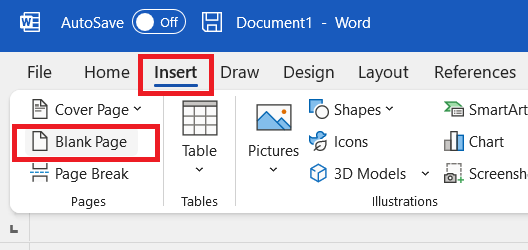
Blank Page vs Page Break: What’s the Difference?
Insert → Blank Page is intended to add an empty page at the cursor location. A page break simply starts subsequent content on a new page. Pressing the page-break shortcut twice can leave a blank page between two sections of text, but the result depends on where the cursor is and the surrounding content. For a dedicated blank page, the Insert command is usually clearer.
How to Remove an Unwanted Blank Page
Turn on formatting marks with Home → ¶ to reveal page breaks and empty paragraphs. Delete only the extra page break or paragraph marks that are creating the unwanted page. Be careful with section breaks: removing one can change headers, footers, page numbering, and orientation in the surrounding sections.
Troubleshooting Blank Pages in Word
- The shortcut moves text but does not leave an empty page: You inserted one page break. Use Insert → Blank Page or place a second break where appropriate.
- A blank page appears at the end of a table: Word requires a paragraph after a table, which can sometimes move to another page. Inspect the paragraph formatting rather than deleting the table.
- The document’s formatting changes: Check whether the page uses a section break rather than a regular page break.
Related Posts
Common questions
Can I insert a blank page in Word for the web?
Word for the web supports inserting page breaks, but the dedicated Blank Page command and layout controls can differ from desktop Word. If you cannot find Blank Page, open the document in desktop Word, or use page breaks and check the result in Print Layout.
Why does Word add an unexpected blank page?
Extra paragraph marks, manual page breaks, odd-page section breaks, and the required paragraph after a table can create unexpected pages. Show formatting marks (¶), identify the cause, and avoid deleting a section break without checking page numbering and headers.
How do I keep a blank page when editing?
Use a deliberate page break or section break where appropriate instead of repeatedly pressing Enter. Word repaginates as content changes, so inspect the document again before printing or exporting to PDF.

C P Gupta is a YouTuber and Blogger. He is expert in Microsoft Word, Excel and PowerPoint. His YouTube channel @pickupbrain is very popular and has crossed 9.9 Million Views.