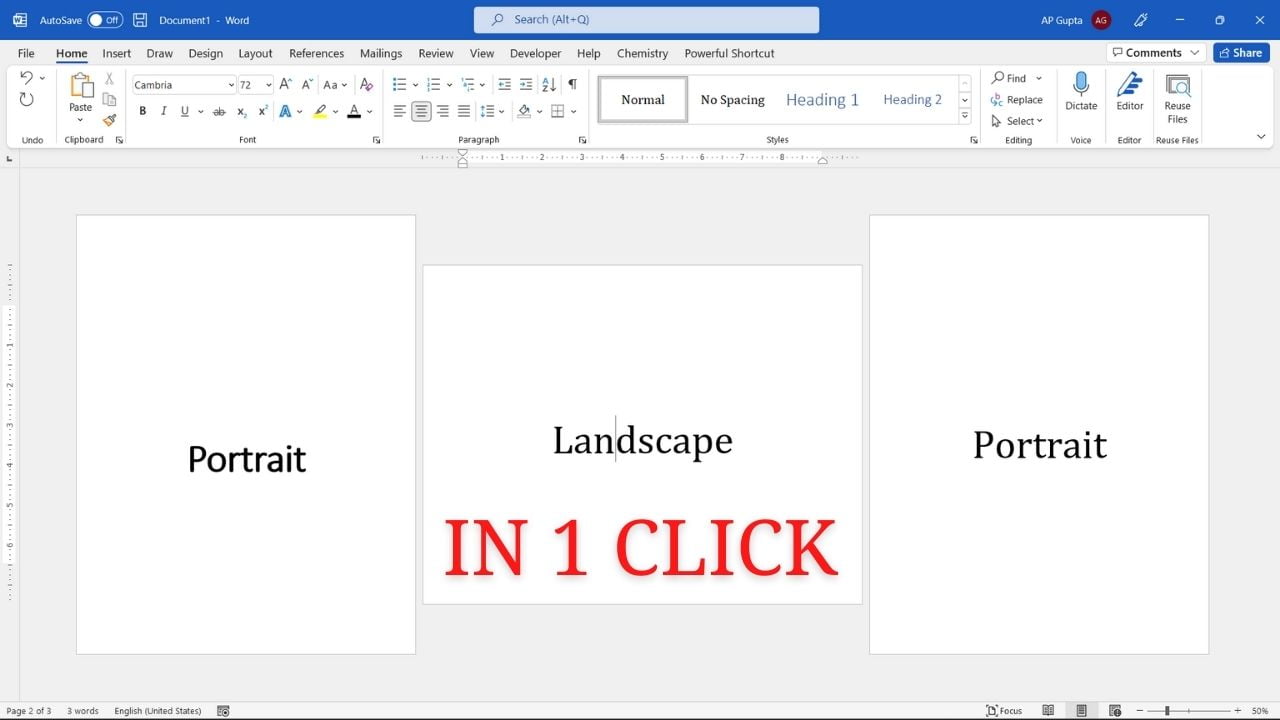
Quick answer: To make only selected content landscape in desktop Microsoft Word, select that content, open Layout → Page Setup, choose Landscape on the Margins tab, and set Apply to: Selected text. Word creates the section boundaries needed to change orientation without turning the whole document landscape. See the video demonstration below.
Make Selected Content Landscape: Step by Step
Step 1: Select the paragraphs, table, or image that should appear on a landscape page. For a blank landscape section, insert a paragraph at the desired location; selecting a blank paragraph may work, but manually inserting section breaks offers more predictable control.

Step 2: On the Layout tab, click the small dialog launcher in the Page Setup group to open the full Page Setup dialog.

Step 3: On the Margins tab, select Landscape. In the Apply to menu, choose Selected text. This option is available when content is selected.

Step 4: Click OK and inspect the page boundaries. Word may add section breaks automatically; if the selected content spans more than one page, more than one page may become landscape.
Video demonstration
Alternative: Use Section Breaks for One Landscape Page
- Place the cursor before the content that needs landscape orientation.
- Choose Layout → Breaks → Next Page under Section Breaks.
- Place the cursor after that content and insert another Next Page section break.
- Click inside the middle section, choose Layout → Orientation → Landscape, and verify that only the middle section changed.
Troubleshooting Page Orientation
Every page turns landscape: The orientation change probably applied to the whole document rather than the selected text or section. Undo, select the desired content, and check the Apply to setting.
Unexpected blank pages: Turn on formatting marks with Home → ¶ and inspect the section breaks. A Next Page break starts a new page; an Odd Page break can intentionally insert a blank page.
Page numbers restart: Section breaks can change header/footer and numbering behavior. Check Insert → Page Number → Format Page Numbers and choose Continue from previous section where appropriate.
Frequently Asked Questions
Can I make exactly one page landscape if it contains a large table?
Yes, provided the table fits on that page. Put a Next Page section break before and after the table, then change the middle section to Landscape. If the table flows onto another page, Word will keep that additional page in the same landscape section; adjust table size, margins, or content rather than expecting orientation to apply to one physical page regardless of overflow.
Why does the next page also turn landscape?
Page orientation is a section-level setting in Word. Insert a section break after the landscape content, then click in the following section and set its orientation to Portrait. A normal page break alone does not create a new section.
Can I change just one page in Word for the web?
Section-level page setup features may be unavailable or limited in Word for the web. For reliable mixed portrait and landscape sections, open the document in desktop Word and use section breaks. Existing section formatting may still display when you return to the web version.
Related guide: If a wide table still extends beyond the landscape page, see how to fit a Word table within page margins.

C P Gupta is a YouTuber and Blogger. He is expert in Microsoft Word, Excel and PowerPoint. His YouTube channel @pickupbrain is very popular and has crossed 9.9 Million Views.