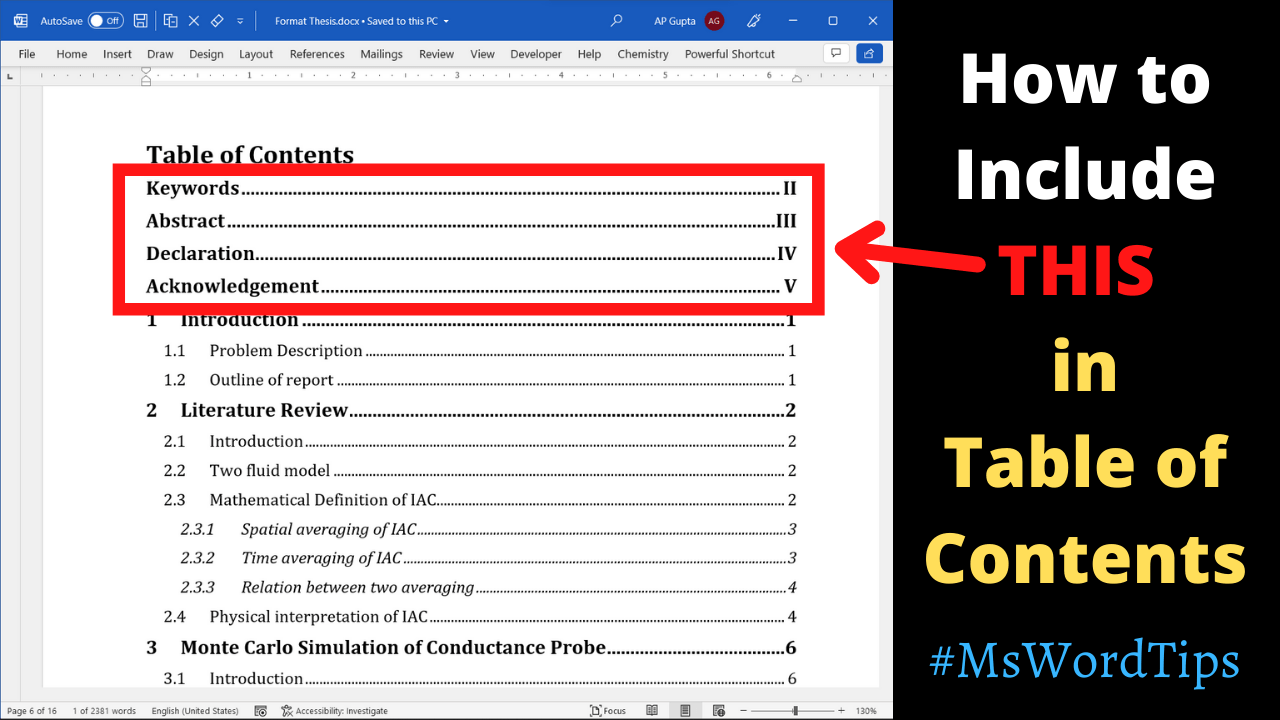
An abstract, acknowledgements or references heading can appear in a Microsoft Word table of contents without becoming a numbered chapter. The safest method depends on how the document’s heading styles and multilevel numbering are configured.
Method 1: Add an unnumbered abstract to the table of contents
These steps apply to desktop Word and retain the existing illustrated workflow. They are useful when you want an Abstract or Acknowledgements entry at TOC level 1 without assigning the numbered chapter Heading 1 style. Save a copy of a long thesis before changing styles or multilevel numbering.
- Select the complete Abstract heading paragraph (or place the insertion point within it). Do not select the entire abstract body.
- On the Home tab, expand the Styles gallery. The exact gallery controls vary with Word version and window width, as illustrated below

- Choose Create a Style if available. Alternatively open the Styles pane and create a new paragraph style

- Name the new paragraph style Pre-Heading (or Front Matter Heading) and save it. If the style already exists, modify or apply it instead of creating a duplicate. Keep it separate from the numbered Heading 1 style.

- With the Abstract paragraph selected, choose References > Add Text > Level 1 to mark it for inclusion in the TOC. If you want all paragraphs using this style included consistently, use the style-mapping method explained below instead.

- Choose References > Update Table and select Update entire table (not just page numbers), then confirm. If the document has no automatic TOC yet, insert one from References > Table of Contents first.

- Check that the Abstract entry appears at the intended level, with the correct page number and hyperlink, as shown in this example.

- To add any other heading/text in TOC,
- Apply the saved Pre-Heading style from Home > Styles to the other unnumbered heading.
- Repeat the Add Text > Level 1 and Update entire table steps. For many headings, the style-based method below is easier to maintain.


Video demonstration
Related Posts
Method 2: Map a custom heading style to TOC level 1
For theses with several unnumbered headings, style mapping is usually more maintainable than marking entries one at a time. Apply the custom Pre-Heading paragraph style to Abstract, Acknowledgements, and similar headings. Then open References > Table of Contents > Custom Table of Contents > Options. In the styles list, enter 1 next to Pre-Heading and confirm. Update the entire table. Keep Heading 1 mapped to level 1 for numbered chapters.
Important: Word’s built-in Heading 1 can be linked to multilevel numbering. Applying it to Abstract may create an unwanted chapter number. A separate unnumbered style avoids that problem. If an entry still receives a number, inspect the paragraph’s numbering and the multilevel-list style links rather than deleting the number from the generated TOC.
Troubleshooting: abstract missing, numbered, or duplicated
- Abstract is missing: confirm it uses the intended paragraph style or was marked with Add Text; check TOC Options and choose Update entire table.
- Abstract has a chapter number: use a separate unnumbered style and inspect multilevel-list settings. Do not edit the generated TOC entry directly.
- Entry appears twice: inspect whether the same paragraph is included by both a heading-style mapping and a separate TOC entry mechanism, such as a TC field; remove the redundant source and rebuild the TOC.
- Page number is wrong: update the entire TOC after pagination changes; check section breaks and page-number formatting.
- Word for the web: advanced TOC style mapping and field-code editing may require desktop Word. Use the desktop app for complex thesis formatting.
Frequently asked questions
Should Abstract use Heading 1? Not if Heading 1 is linked to automatic chapter numbering. Use a separate paragraph style mapped to TOC level 1.
Can I add References and Acknowledgements the same way? Yes. Apply the same unnumbered style and update the entire TOC.
Why do manually typed TOC entries disappear? An automatic TOC is generated from document headings and fields. Rebuilding it overwrites manual edits; change the source heading or TOC configuration instead.
Worked example: front matter before Chapter 1
Suppose a thesis begins with Abstract on page iii and Acknowledgements on page iv, followed by numbered Chapter 1 on page 1. Apply the same unnumbered Pre-Heading style to the first two headings, map that style to TOC level 1, and keep numbered Heading 1 for chapters. After updating the entire table, verify that the TOC shows all three headings at the intended level without assigning chapter numbers to the front matter. Roman and Arabic page numbering require separate section/page-number configuration; TOC mapping alone does not change them.
Alternative: a TC field
Advanced users can mark a specific entry with a TC (table of contents entry) field and configure the TOC to include TC fields. This is useful when you do not want a paragraph style included automatically, but the field must be maintained when headings change. Avoid manually typing entries into the generated TOC because updating the table can overwrite them.
Refresh and verify the TOC and accessibility
After changing a heading or TOC options, right-click the table and choose Update Field, then update the entire table when prompted. Check the entry text, page numbers and hyperlink targets in the document and any exported PDF. Use a true paragraph style with an appropriate outline level for navigable headings rather than merely making text bold; a TOC entry alone does not guarantee accessible document navigation. Check the Navigation Pane and accessibility checker before distributing a thesis. For related instructions, see page numbering across sections.

C P Gupta is a YouTuber and Blogger. He is expert in Microsoft Word, Excel and PowerPoint. His YouTube channel @pickupbrain is very popular and has crossed 9.9 Million Views.