Quick answer: In desktop Word for Windows, type 00F7, then press Alt+X to convert the code to ÷. Alternatively, choose Insert → Symbol → More Symbols. On Mac or Word for the web, use the Symbol picker or paste ÷. Its Unicode code point is U+00F7.
Method 1: Insert > Symbol
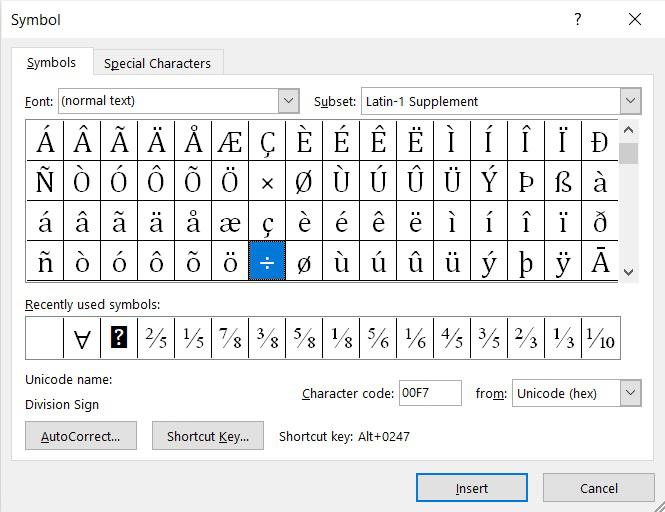
- Navigate to Insert Tab > Symbols and click on More Symbols.. to open Symbol window
- Select normal text in Font and Latin-1 Supplement in Subset
- Search for ÷ symbol and double click to insert.
- Select Close after inserting the symbol
Method 2: Math Autocorrect Shortcut
In an equation, type \div and press Space to convert it to ÷ when Math AutoCorrect is active. Outside an equation, this expansion depends on the desktop Word setting described below; it is not guaranteed in Word for the web.
Steps to Enable Math Autocorrect Outside Equation Editor
- Click File → Options to open Word Options
- Navigate to Proofing and click AutoCorrect Options button to open Auto Correct window
- Navigate to Math Autocorrect tab
- Check the box against “Use Math Autocorrect options outside Math region“
- Click Ok and close all the dialog boxes.
Method 3: Alt Code
Number pad keys on keyboard opens up the third shortcut to insert division symbol. On Windows with a numeric keypad, hold Alt and type 0247 on the numeric keypad, then release Alt. This legacy input method depends on the application and keyboard configuration; it is not the same as the reliable Unicode 00F7, Alt+X method in Word. Do not use the number row.
Summary
Three methods to insert division sign in Word are as follows
| Method | Description |
|---|---|
| Insert > Symbol | Navigate to Insert Tab > Symbols and click on More Symbols. Select normal text in Font and Latin-1 Supplement in Subset and double click on ÷ symbol to insert it |
| Math Autocorrect Shortcut | Type \div and press space. It works in equation editor, but with one time setting, it can work outside equation editor too. |
| Alt Code | In Windows desktop Word, try Alt+0247 using the numeric keypad; results may vary by environment. Prefer 00F7 then Alt+X. |
Method 4: Unicode 00F7 + Alt+X (Windows desktop)
- Place the cursor where you want the division sign.
- Type
00F7without a precedingU+. - Press Alt+X to replace the code with ÷. If the wrong characters convert, separate the code from adjacent hexadecimal letters or select only
00F7before pressing Alt+X.
Division Sign vs Slash vs Fraction
Use ÷ for arithmetic notation such as 12 ÷ 3 = 4, / for plain-text division such as 12/3, and Insert → Equation → Fraction for a stacked fraction. For an equation layout, see Word equation editor shortcuts.
Frequently Asked Questions
Why does Alt+X not insert ÷?
Alt+X is a Unicode conversion shortcut in desktop Word for Windows. It may not work in the same way in Word for the web, and a neighboring hexadecimal character can affect which code Word converts. Select 00F7 before trying again.
Can I type ÷ in Word on a Mac?
Yes. Use Insert → Advanced Symbol when available, or macOS Character Viewer to find “division sign”; you can also copy and paste ÷. Menu names vary by Word version.
Why does \div remain as text?
Math AutoCorrect usually expands inside an equation region. Insert an equation first and press Space after the command. Outside equations, check the Math AutoCorrect setting in desktop Word.
Related Posts
Important Details and Troubleshooting
The division sign ÷ and slash / are both used for division in different contexts. For a stacked numerator and denominator, use Word’s Equation → Fraction tools instead.

C P Gupta is a YouTuber and Blogger. He is expert in Microsoft Word, Excel and PowerPoint. His YouTube channel @pickupbrain is very popular and has crossed 9.9 Million Views.