To insert a 4×4 matrix in Microsoft Word, the most reliable method is to use the built-in Equation gallery, choose a 3×3 matrix, then add one row and one column. On compatible desktop versions, UnicodeMath linear input can also create matrices quickly; it is not the same as typing a matrix into ordinary body text.
Method 1: Build a 4×4 matrix with the Equation gallery
- Place the cursor where the matrix should appear. Select Insert → Equation (or press Alt+= in desktop Word for Windows).
- With the equation selected, open the Matrix gallery on the equation ribbon and choose a 3×3 matrix.
- Right-click inside a matrix cell and choose Insert → Insert Row Below (or Above); repeat for Insert Column After (or Before).
- Fill all 16 cells. Use the equation Bracket gallery if you need square brackets or parentheses around the matrix.
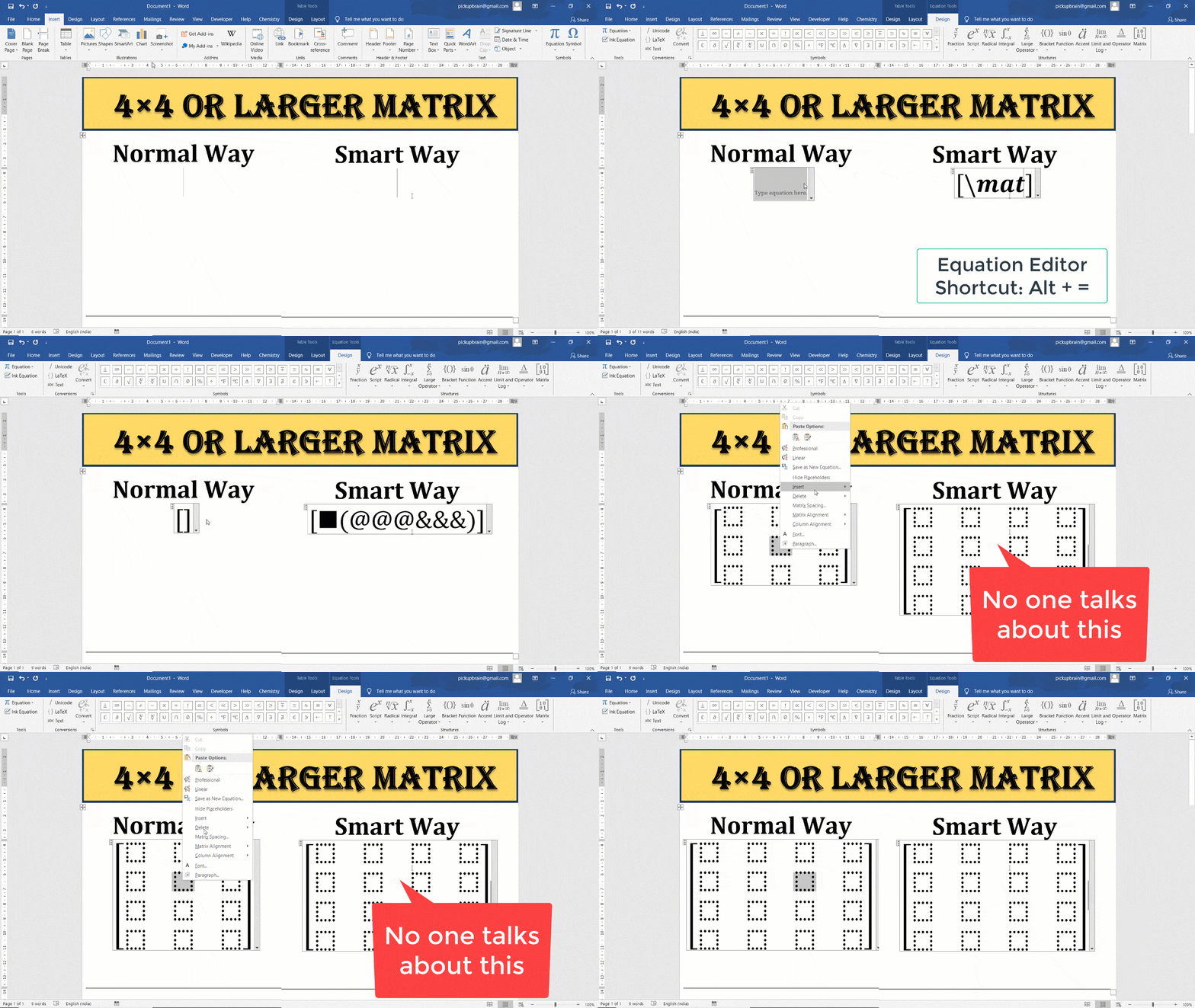
The original animation compares insertion approaches. Menu names and ribbon layouts vary between Word versions.
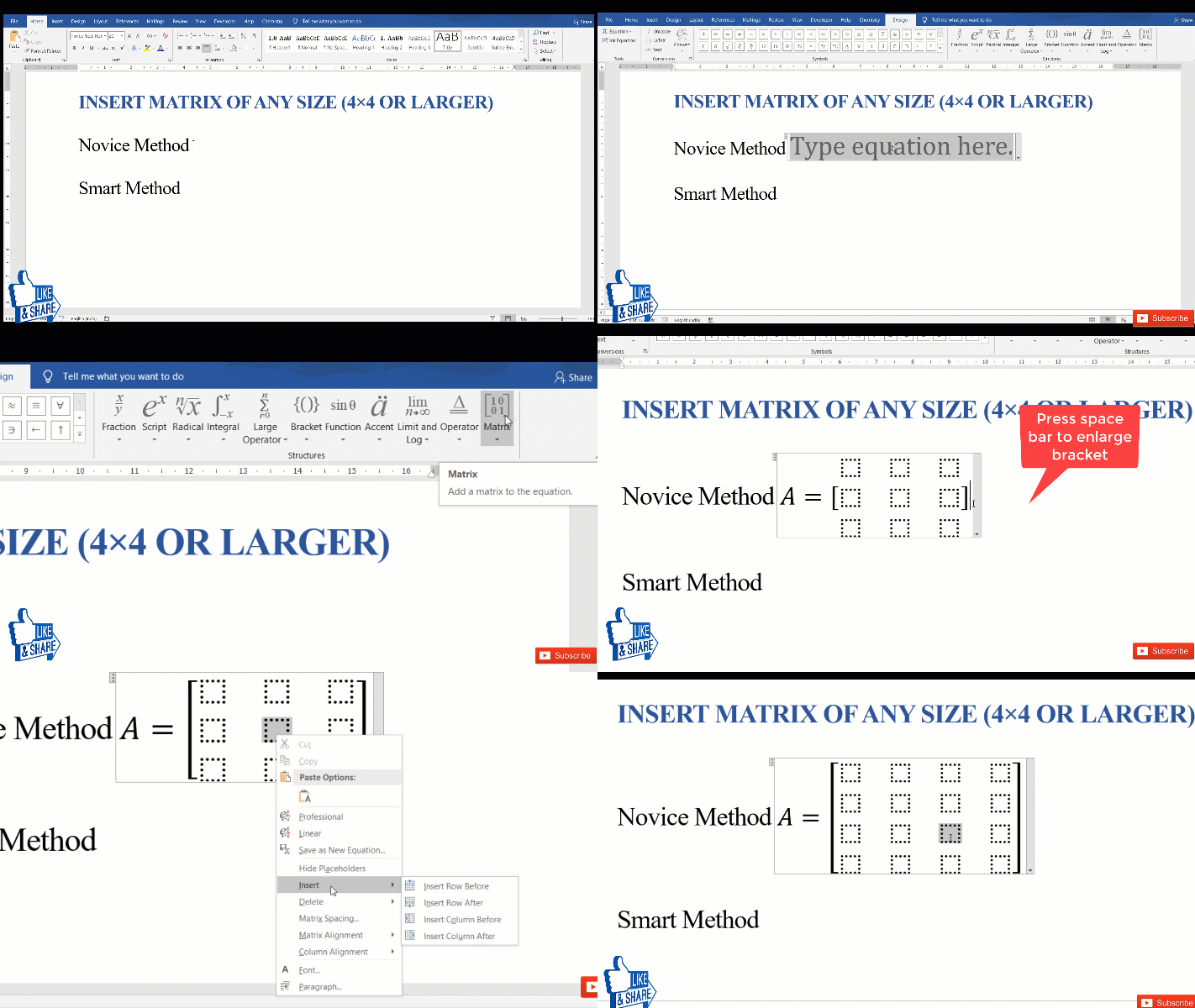
Method 2: UnicodeMath linear input on supported desktop Word
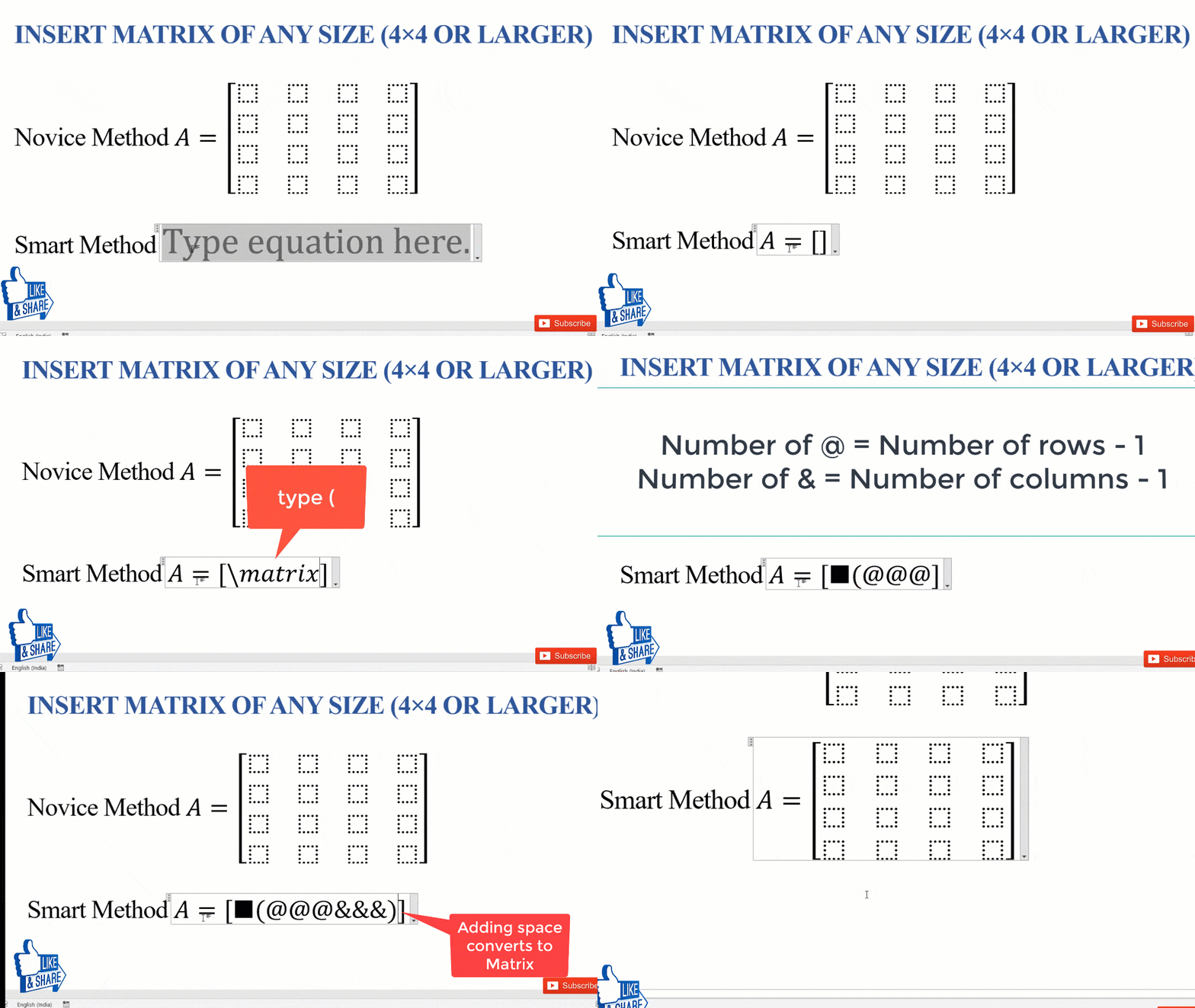
Inside a Word equation in UnicodeMath input mode, the linear matrix form uses \matrix(...), with & between columns and @ between rows. For example, a 4×4 matrix with values 1 through 16 can be written as \matrix(1&2&3&4@5&6&7&8@9&10&11&12@13&14&15&16). This example has four entries in each of four rows. Enter it inside an equation and use the equation conversion control as needed. Linear parsing varies by Word version and input mode; the Matrix gallery above is the dependable fallback. Do not use the older shorthand \matrix(@@@&&&) as a general 4×4 template: its separators do not explicitly define all 16 cells.
After typing a recognized linear command in a Word equation, press Space or use the equation ribbon’s conversion command to build it up. If Word displays the text literally, check that the cursor is inside an equation and the input format is UnicodeMath rather than LaTeX. Avoid assuming that Word for the web or every Mac version supports the same conversion behavior.
Troubleshooting and accessibility
- Matrix command stays as text: Confirm you are editing an equation, not a normal paragraph; try the Matrix gallery instead.
- Wrong number of cells: Inspect row and column separators and rebuild using the gallery when unsure.
- Brackets look uneven: Use the equation Bracket gallery so delimiters resize with the matrix.
- Exporting to PDF: Check the resulting PDF visually and ensure the surrounding text explains what the matrix represents; do not rely on the image animations as the only instruction.
Frequently asked questions
Can I create a 5×5 or larger matrix?
Yes. Insert a smaller matrix and add rows and columns until it reaches the desired dimensions. This works without memorizing linear syntax.
Does this work in Word for the web?
Equation editing capabilities vary by platform and account. If the matrix gallery or row-insertion controls are missing, open the document in desktop Word.
Related tutorials
See our matrix insertion guide and Word equation shortcuts.
More useful post on Ms Word shortcut

C P Gupta is a YouTuber and Blogger. He is expert in Microsoft Word, Excel and PowerPoint. His YouTube channel @pickupbrain is very popular and has crossed 9.9 Million Views.