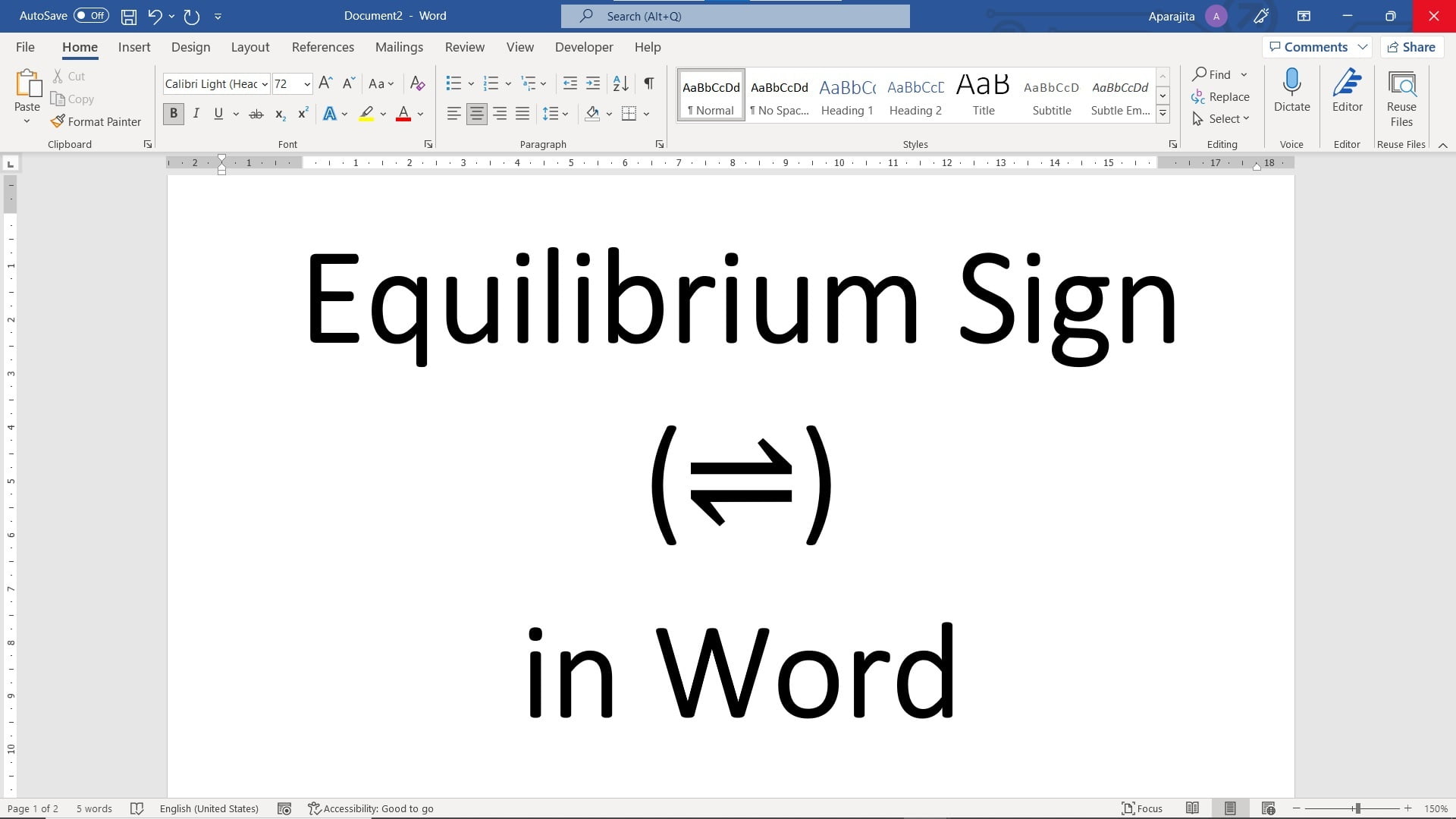
Quick answer: To type the equilibrium arrow ⇌ in desktop Microsoft Word for Windows, enter 21CC and press Alt+X. For the opposite-direction arrow ⇋, use 21CB and Alt+X. You can also insert these symbols from Word’s Symbol dialog or through Equation tools. This guide explains three practical methods and the important distinction between the two arrow forms.
Three ways to insert an equilibrium arrow in Word
Method 1: Insert the arrow from the Symbol menu
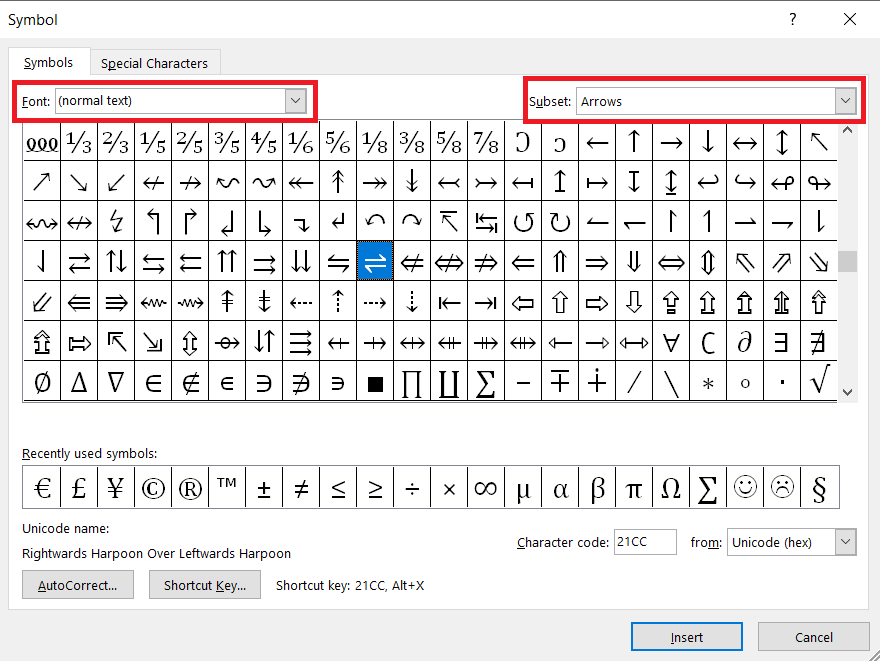
- Go to Insert → Symbol → More Symbols.
- Choose a font that contains the symbol (such as Cambria Math) and select the Arrows subset if available.
- Select ⇌ (Unicode U+21CC, rightwards harpoon over leftwards harpoon) and click Insert.
Method 2: Use Equation tools and Math AutoCorrect
Word’s equation editor supports Math AutoCorrect commands for many mathematical arrows. On desktop Word for Windows, press Alt+= to insert an equation, then use a supported command and press Space. Math AutoCorrect outside equations is an optional setting and behavior can vary by Word version.
For a reversible-reaction arrow in an equation, try \lrhar followed by Space in a Word equation field. If your version does not recognize that command, use Insert → Symbol or the Unicode Alt+X method instead.
Complete list of equation editor shortcut for Arrows are available here.
Method 3: Type the Unicode code and press Alt+X
For ⇌, type 21CC and press Alt+X. For ⇋, type 21CB and press Alt+X. These are two different Unicode characters, not interchangeable codes for the same symbol. If Alt+X converts unexpected preceding text, type the code separately or select just the four hexadecimal digits before pressing Alt+X.
Which Equilibrium Arrow Should You Use?
The symbols ⇌ (U+21CC) and ⇋ (U+21CB) point in opposite harpoon arrangements. In chemistry, reversible-reaction notation can also use different paired arrows depending on the textbook, publisher, or style guide. Match the symbol used in your course or document instead of assuming all equilibrium arrows are identical.
Troubleshooting Equilibrium Symbols in Word
- Alt+X does nothing: Use the desktop Word for Windows editor and place the cursor immediately after the hexadecimal code. On Mac or Word for the web, use Insert → Symbol or the operating system’s character picker instead.
- The symbol looks different: Try Cambria Math or another Unicode-capable font. Appearance varies by font.
- Need arrows with labels above or below? Use Word’s equation structures. See the related guide to chemical reaction arrows in Word.
Equilibrium arrows versus ordinary reaction arrows
The single arrow → is commonly used to show a reaction proceeding in the written direction. A paired equilibrium arrow, such as ⇌, indicates a reversible reaction and is frequently used for chemical equilibrium. The opposite harpoon arrangement ⇋ is a separate Unicode character. In a scientific manuscript, follow the notation specified by the relevant journal, textbook, or instructor; a visually similar glyph is not necessarily the intended symbol.
Example: You can write N₂(g) + 3H₂(g) ⇌ 2NH₃(g) as plain text. For publication-quality chemical equations, use Word’s equation editor to format subscripts consistently and check spacing, fonts, and line wrapping before exporting to PDF.
Insert an equilibrium arrow on Mac or in Word for the web
- Mac: copy ⇌ from this page or open the macOS character picker with Control + Command + Space, then search for an arrow symbol. Character-picker results depend on the operating system and font.
- Word for the web: paste the Unicode arrow into the document. If it renders as a box or a different-looking glyph, try a Unicode-capable font in the desktop app.
- Across platforms: use the same Unicode character in the document rather than substituting a pair of manually positioned arrow shapes. Shapes can shift when text reflows.
Check the symbol before sharing your document
- Confirm that the intended character is ⇌ (U+21CC) or ⇋ (U+21CB), as required.
- Check the arrow next to the chemical formula at normal zoom and after exporting to PDF.
- Check that subscripts and superscripts remain legible and that the arrow is not replaced by a missing-glyph box.
- For accessible documents, explain the reaction’s meaning in the surrounding sentence rather than relying on the symbol alone.
Related reading: See our reaction arrows in Microsoft Word guide for additional equation arrow styles and labels.
Frequently asked questions
Can I copy and paste the equilibrium arrow?
Yes. Copy ⇌ (U+21CC) or ⇋ (U+21CB) from this page and paste it into Word. If it appears as an empty square, try a font that supports the character, such as Cambria Math.
Why does the arrow look different in an equation?
Word’s equation editor uses mathematical fonts and layout rules that can change the arrow’s appearance. Verify the actual Unicode character and use the symbol required by your chemistry style guide rather than relying only on visual similarity.
Can I use Alt+X in Word for Mac or Word for the web?
The hexadecimal Alt+X method described here is for desktop Word on Windows. On other platforms, paste the symbol or use the available symbol or character-insertion tools.
Related Posts

C P Gupta is a YouTuber and Blogger. He is expert in Microsoft Word, Excel and PowerPoint. His YouTube channel @pickupbrain is very popular and has crossed 9.9 Million Views.