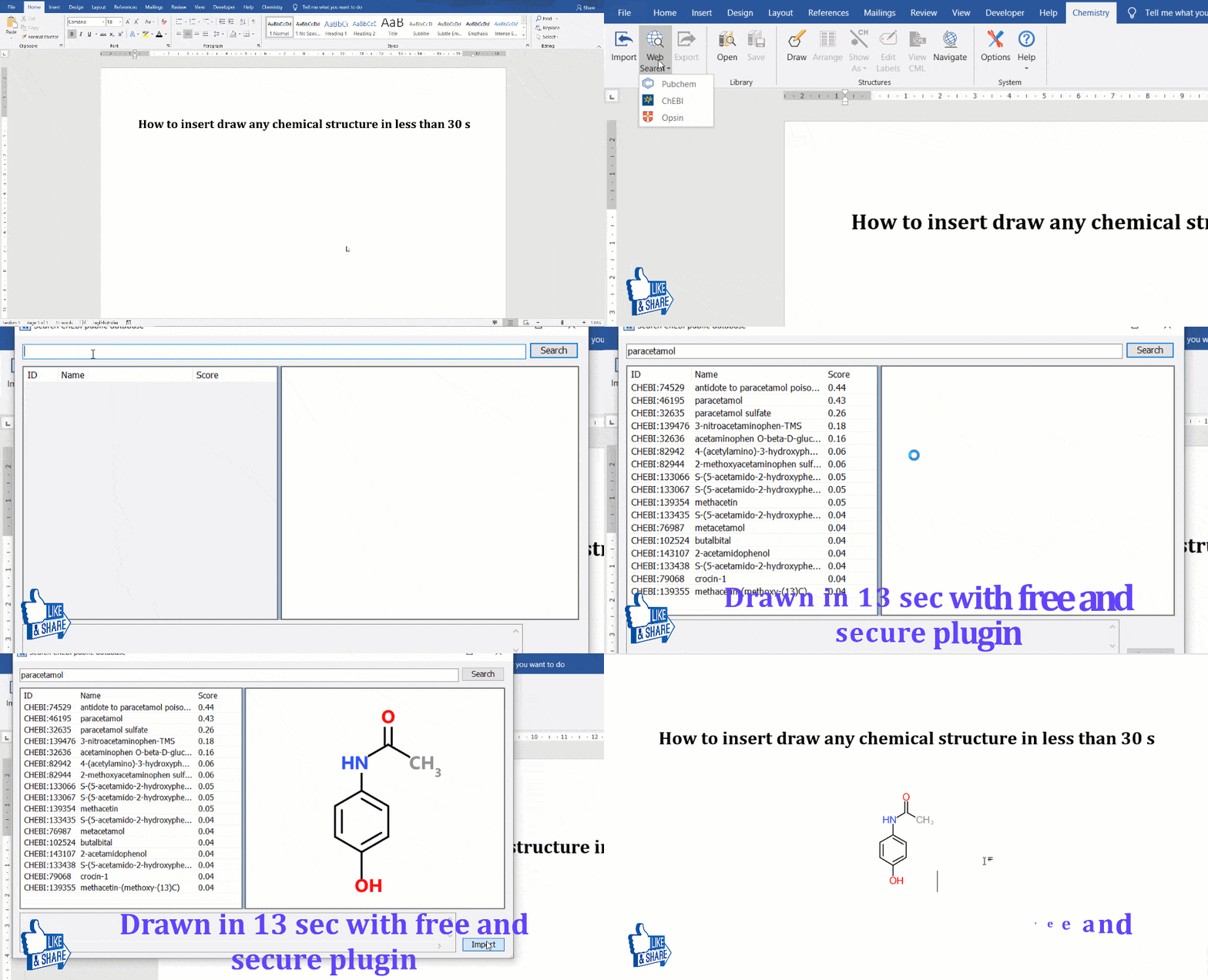
To add a chemical structure to Microsoft Word, you can draw bonds and atoms with a dedicated chemistry tool rather than Word’s ordinary Shapes menu. Chem4Word (Chemistry Add-in for Word) is one such project for compatible desktop Word on Windows. This tutorial explains where to find its current releases, how to insert or import a structure, and how to avoid outdated installers and chemistry errors.
What is Chem4Word?
Chem4Word is a chemistry-aware add-in for Word that can create and render two-dimensional chemical structures. Depending on its version and installed components, it can support drawing molecular diagrams, importing supported chemical file formats, and editing structure information in documents. It is not a replacement for validating molecular identity, chemical valence or publication-quality chemical nomenclature.
The original article linked to Chem4Word Version 3.0.33 and required an old .NET Framework/Office combination. That older repository is now marked obsolete by the project. For new installations, start at the official current Chem4Word 3.3 releases or the project website, rather than assuming the 2020 download and dependencies are still correct.
Before you install: compatibility and safety
- Platform: Chem4Word is for compatible desktop Microsoft Word on Windows. Do not assume it will run inside Word for the web or Word for Mac.
- Word and Windows versions: check the release notes for the exact supported Microsoft Office and Windows editions, processor architecture, and components required by the build you select.
- Dependencies: use the release’s current .NET and Office integration requirements rather than installing an obsolete framework solely from an old tutorial.
- Source: download only from the official project site or its maintained GitHub release repository. Avoid repackaged third-party installers.
- Permissions: your institution or employer may block Office add-ins, require an approved installation, or restrict data sent to online chemistry services.
How to install Chem4Word in Microsoft Word
- Close Word and save any open documents.
- Visit the official Chem4Word website or its maintained release page. Read the release notes and identify the compatible installer for your Word installation.
- Check the installer’s source and the release-specific prerequisites. Where the project provides signatures or hashes, verify the download.
- Run the installer using the permissions your system requires, following the prompts rather than the historical v3.0 instructions.
- Open desktop Word and look for the Chemistry ribbon/tab or the add-in controls. If it does not appear, check Word’s installed and disabled add-ins and the project’s setup documentation.
If an add-in is disabled or Word blocks it as untrusted, check your institution’s policy and official support documentation. Do not disable Office macro protections or security features merely to force an unknown installer to run.
Method 1: Draw a molecule in the chemistry editor
- Open Word and select the Chem4Word drawing/editor command from the Chemistry tab. The command label depends on the installed release.
- Choose suitable atom, bond, ring, or other structure tools in the editor.
- Draw a simple test structure first, such as a benzene ring with its alternating-bond representation.
- Check bond orders, connected atoms, charges and chemical meaning carefully before inserting the structure into Word.
- Insert the structure into the document. If your add-in supports an editable chemical object, retain that original editable form in the source document and verify it remains editable after saving.

The screenshot above illustrates the original Chem4Word drawing interface; controls and layout may be different in newer builds. A structure that looks visually attractive is not necessarily chemically valid: confirm molecular formulas, charges and stereochemistry using an authoritative chemical source.
Method 2: Import an existing chemical structure
Chem4Word versions have supported structure imports and chemistry integrations such as PubChem or chemical file formats. The options available to you depend on your actual installed release and the relevant online services. A database lookup can return multiple related compounds, salts, isomers or tautomers, so check the result before inserting it.
- Open the add-in’s import/search function.
- If it offers a molecular-name search, enter a precise chemical name, identifier or compound record and review the results.
- Confirm you selected the correct structure and form of the compound; for a drug substance, the free base and a citrate salt are not chemically identical.
- Insert the selected structure into the document and keep an appropriate source record for scientific citation.

The historic screenshot demonstrates an import involving sildenafil citrate. It should not be treated as proof that every online integration or compound query still works in the current release. For chemical identities, cross-check a source such as PubChem.
When Word’s built-in equation editor is enough
For a straightforward text formula such as H₂O, CO₂ or NaCl, you might not need a chemistry add-in. Word’s subscript formatting and equation editor can handle text notation. Use a dedicated chemical drawing tool for proper structural diagrams with bonds, ring topology, stereochemistry and editable molecular objects. For reaction arrows and chemical equations, see our chemical reactions in Word guide.
Chem4Word compared with alternative tools
Chem4Word is convenient if you want a chemistry-specific editing experience inside supported desktop Word. A stand-alone chemical editor can be an alternative when you need other structure formats, cross-platform access or more specialized drawing. Compare required features, Word integration, licensing and current version support before choosing an editor.
Frequently asked questions and troubleshooting
- Why does the Chemistry tab not appear? The add-in may not be installed for this Word user, may be disabled, or may be incompatible with the running Word edition. Review Word add-in settings and the project’s current release instructions.
- Will Chem4Word work in Word for the web? Do not assume so: this tutorial covers the compatible desktop Windows add-in.
- Is every compound in the import search? No. Coverage and search behavior depend on the source database and its current availability.
- Why is the imported structure different from what I expected? Verify the compound identity, charge, stereochemistry and salt form; chemical names can be ambiguous.
- Can colleagues edit the diagram? Only if they have a compatible workflow and the original editable chemical representation is retained. An exported screenshot is not an editable chemical structure.
Conclusion
For chemical structure drawings in desktop Word on Windows, Chem4Word can be useful when a compatible release is available. Start with the maintained Chem4Word 3.3 project, verify requirements and chemical identity, and keep editable structure data when collaborating. The original article’s screenshots remain above as historical illustrations.
Other related post you may like

C P Gupta is a YouTuber and Blogger. He is expert in Microsoft Word, Excel and PowerPoint. His YouTube channel @pickupbrain is very popular and has crossed 9.9 Million Views.
We are currently working on Version 2020 of Chem4Word.
The installer for this can be found at https://github.com/Chem4Word/Version3-1/releases/latest
The most interesting part (to the end-user) is our new in house editor.
In our editor, we support a pre-defined list of Functional Groups as well as groups of nested molecules.
We have done this to allow us to support reactions in a future release.
There are also some [primarily] cosmetic bug fixes included in Version 2020.
Regards
Mike Williams
Chem4Word Project Management Committee
I’m extremely impressed with your writing skills and also with the layout on your weblog. Is this a paid theme or did you modify it yourself? Either way keep up the nice quality writing, it?s rare to see a nice blog like this one nowadays..
Thanks for your complement.This is just a drift blog theme.
Thanks dear. Its free theme.
Hi, after importing chemical structure to word, how to resize it??
please how can i download Chem4word plugin?
Blog has an installation procedure section where you can find the link to plugin. Hope this helps.
can it also work in office 2019
Yes, as per official documentation Chem4Word/Version-3.1 it works with Word 2019 too. For complete requirements and prerequisite, you may see its official documentation https://github.com/Chem4Word/Version3-1/blob/master/docs/Chem4Word-Version3-1-User-Manual.docx
I did not check but it may work on Office 2019 too.
excellent
Thanks Dear ☺
Thanks!