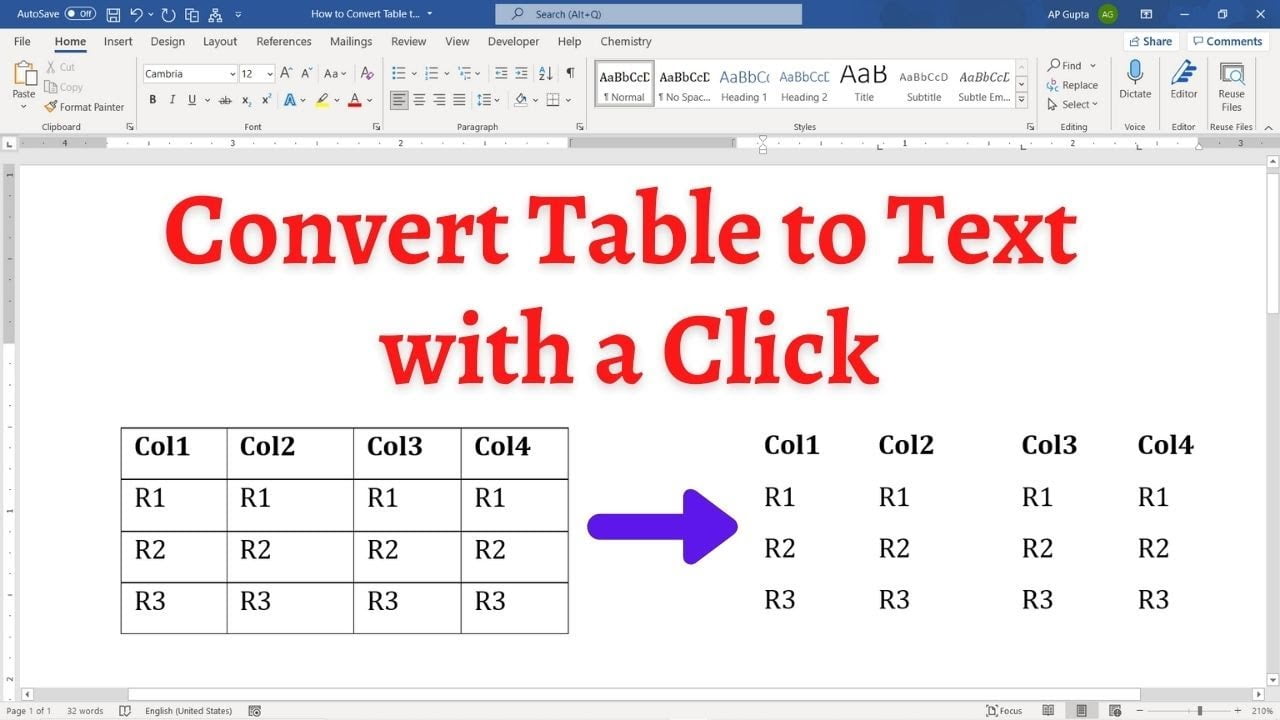
Quick answer: To convert a Word table into ordinary text, select the table, open the contextual Table Layout tab, and choose Convert to Text. Select a separator such as tabs or commas, then confirm. Word removes the table structure and places a separator between cell contents while keeping each table row on a separate line.
Convert a Word Table to Text: Step-by-Step
- Select the table or the rows you want to convert. To select the whole table, click the four-arrow handle near its upper-left corner.

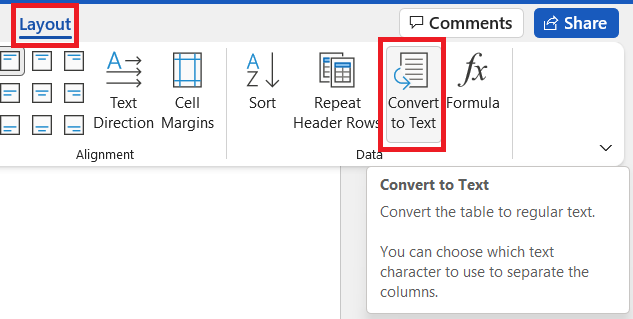
- With the table selected, open the contextual Table Layout tab (called Layout under Table Tools in some versions). In the Data group, choose Convert to Text. The regular page-layout tab is not the one you need.
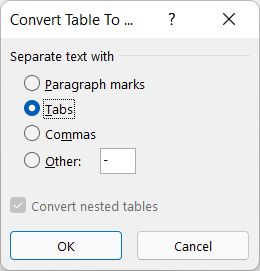
- In the Convert Table to Text dialog, choose how to separate former columns: Tabs, Commas, Paragraph marks, or Other. Tabs are useful if you want to keep columns visually aligned; commas can be useful for simple delimited data. Existing commas in cell content can make a comma-separated result ambiguous.
- Click OK to convert the selected table. Check the resulting paragraphs and separators. If the result is not what you expected, immediately press Ctrl+Z (Windows) or Command+Z (Mac) to undo.
Video: Convert a Table to Text in Word
Which Separator Should You Choose?
- Tabs: Best for text that may later be converted back into a table or pasted into a spreadsheet.
- Commas: Suitable for simple lists, but use care when cells already contain commas; Word does not automatically create a fully quoted CSV file.
- Paragraph marks: Places each cell’s content into its own paragraph, rather than preserving columns on a single line.
- Other: Lets you specify a custom separator character.
Example: Convert a Two-Column Table
Suppose your table has two columns, Name and Department, with a row containing Asha and Finance. Choosing Tabs produces a line with Asha, a tab character, and Finance. Choosing Paragraph marks places Asha and Finance on separate paragraphs. Choose the separator based on how you plan to reuse the text.
Troubleshooting and Important Limitations
Convert to Text is unavailable: Make sure your cursor is inside a real Word table and that the contextual Table Layout tab is visible. Word for the web may not provide the same conversion commands as desktop Word.
Formatting changes: The table grid, cell borders, and some layout formatting disappear when you convert the table. Save a copy first if the table is complex or contains merged cells, nested tables, or important formatting.
Want to reverse the process? See how to convert text into a table in Microsoft Word.
Before You Convert: Check Merged Cells and Accessibility
Conversion removes the table’s row and column relationships. For data that readers need to compare across columns, keeping a properly structured table with a header row may be more accessible than converting it to plain text. If the table contains merged cells, nested tables, or line breaks inside cells, convert a copy and inspect the output carefully. A tab-delimited result is not automatically an accessible table or a standards-compliant CSV file.
Frequently Asked Questions
Will Convert to Text delete the words in my cells? The command is intended to preserve the text while replacing table structure with separators. Complex content and formatting may change, so keep a backup and inspect the result.
Can I convert the text back into a table? Usually, yes, if you use a consistent separator such as tabs. Select the converted text and use Insert > Table > Convert Text to Table in desktop Word. Check the column count before confirming.
Why are my columns no longer aligned? Tabs and spaces depend on paragraph tab stops and fonts; plain text does not retain fixed column widths. If precise alignment is important, keep a Word table instead.
Related Posts

C P Gupta is a YouTuber and Blogger. He is expert in Microsoft Word, Excel and PowerPoint. His YouTube channel @pickupbrain is very popular and has crossed 9.9 Million Views.