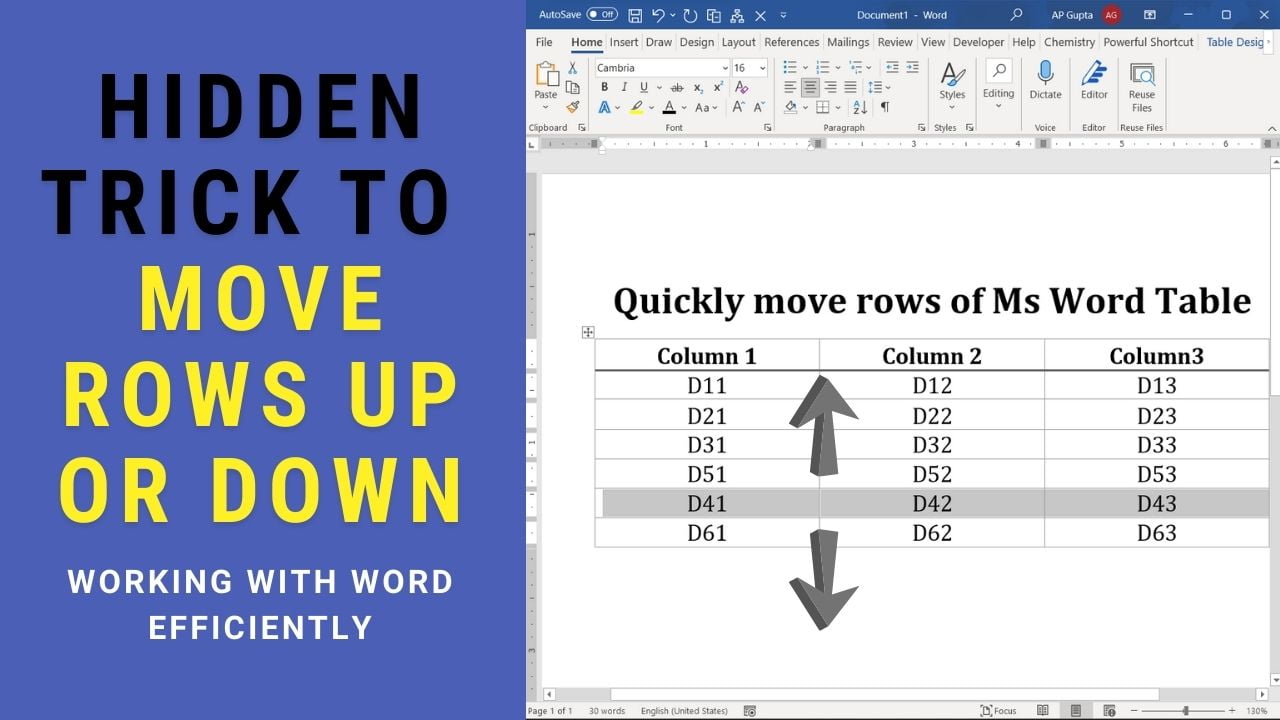
Quick answer: To move a table row in desktop Microsoft Word for Windows, click in the row and press Alt+Shift+Up Arrow or Alt+Shift+Down Arrow. Select adjacent rows first to move them together. This is faster than cutting and pasting, but test the shortcut on a copy if the table contains merged cells or complex formatting.
How to Move a Table Row Up or Down in Word
- Position the cursor in the row you want to move or select the row (or rows) you want to move.
- Hold Alt+Shift and press Up Arrow or Down Arrow to move the selected row or adjacent rows one position at a time.
Note: Moving a row beyond the table boundary can change document structure. Check the result and undo immediately if it is not what you intended. The vertical shortcut does not rearrange columns.
The original video below demonstrates the row-moving shortcut in desktop Word; interface details may differ in current versions.
Before You Move Rows: Check the Table Structure
Save the document before rearranging a complex table. Check for vertically merged cells, nested tables, and header rows that repeat across pages. After moving a row, confirm that each value still appears under the correct column heading. Use Ctrl+Z immediately if the table changes unexpectedly.
Move Several Adjacent Rows Together
Drag across the left margin of the table to select complete, consecutive rows (or use Table Layout → Select → Select Row and extend the selection), then press Alt+Shift+Up Arrow or Alt+Shift+Down Arrow. Move one step at a time and check the result. Nonadjacent row selections and merged cells are less predictable; use a backup and verify the repeated header-row setting.
When the Shortcut Does Not Work
Make sure the insertion point is inside a Word table and the desktop Word window has focus. Some laptop or accessibility keyboard settings intercept Alt+Shift combinations. In that case, save a copy, select the entire row, press Ctrl+X, place the insertion point in the destination row, and paste. Word can insert pasted cells differently depending on the selection, so inspect the table structure, borders and merged cells; use Ctrl+Z if the result is wrong.
Accessibility and document checks
Keep column headings associated with the correct values, especially when the table spans multiple pages. Use Table Layout → Repeat Header Rows for the header row, avoid using merged cells solely for visual spacing, and inspect the document with Word’s Accessibility Checker after reorganizing a complex table.
Frequently Asked Questions
Can I move a row to another table? Select and cut the entire row, then paste into the destination table and check the formatting.
Can I move columns with this shortcut? No. The shortcut moves rows vertically; rearrange columns separately and check merged cells.
Does this work on Mac or Word for the web? Keyboard behavior differs by platform and version. If the shortcut does not work, use the available table controls or carefully cut and paste the selected row.
See also Word table keyboard shortcuts and how to split a Word table.
Safer alternative for complex tables
For a table with vertically merged cells, split cells, or nested tables, first save a duplicate document. Use Table Layout > Select > Select Row to select the complete row; cut and paste only after checking where Word will insert the cells. Do not select just the text inside individual cells: that moves text without necessarily preserving the table row. If the destination has a different number of columns, rebuild the row structure rather than assuming a paste will align values correctly.
Verify the result before sharing
- Confirm that the moved row retains all cell contents, borders, and shading.
- Check the first row’s header designation and repeat-header setting if the table spans pages.
- Review the reading order and headings with Review > Check Accessibility where available.
- Inspect the page layout and exported PDF; table rows can split or shift at page boundaries.
Version note: Alt+Shift+Up/Down is documented for moving selected paragraphs or table rows in desktop Word for Windows. On Mac, Word for the web, or when operating-system shortcuts intercept it, use the available ribbon and cut/paste controls instead of assuming identical keyboard behavior. This guide has not been validated in every Word build.
Worked example: move a data row without moving the header
Imagine a three-column table headed Item | Quantity | Price with rows Pens | 10 | 20, Notebooks | 4 | 60, and Folders | 2 | 45. To place Folders above Notebooks, click anywhere in the Folders row and press Alt+Shift+Up Arrow once in desktop Word for Windows. The intended final order is header, Pens, Folders, Notebooks. Confirm that all three values moved together and that the header stayed at the top. This is an illustrative procedure, not a claim of a live Word test.
Shortcut versus sorting: choose the right operation
Use the keyboard shortcut for a manual one-row rearrangement. If you need all rows sorted alphabetically or numerically, use Word’s table Layout → Sort command where available, identify the header row and choose the appropriate column and data type. Sorting is a different operation: it can rearrange many records at once. For tables with merged cells, inspect whether sorting is available and whether it preserves the intended row groups.
Official keyboard shortcut reference
Microsoft’s Word keyboard shortcuts documentation lists Alt+Shift+Up Arrow and Alt+Shift+Down Arrow for moving a table row up or down in desktop Word. If the keys trigger another action on your computer, use the table controls or a carefully checked cut-and-paste workflow instead.
Related Posts

C P Gupta is a YouTuber and Blogger. He is expert in Microsoft Word, Excel and PowerPoint. His YouTube channel @pickupbrain is very popular and has crossed 9.9 Million Views.