To insert Roman numerals in Microsoft Word, you can type small numbers directly (I, II, III, IV), use a Word field code to convert an Arabic number such as 84 to LXXXIV, or format page numbering with Roman numerals. These are different tasks. For automatic conversion in desktop Word for Windows, use the \* ROMAN field-format switch; to show lowercase numerals, use \* roman.
Method 1: Convert an Arabic number with Word field codes
- Place the insertion point at the desired position in desktop Word for Windows.
- Press Ctrl + F9 to insert an actual pair of Word field braces. Ordinary curly braces typed with the keyboard will not create a functioning field.
- Inside the field braces, enter
=84 \* ROMAN(including a space before\*). The field then resembles{ =84 \* ROMAN }. - Select the field and press F9 to update it. Word should display LXXXIV. On laptops with media-key defaults, you may need Fn + F9.
- To view the field instructions again, press Alt + F9 to switch between the field code and its result.
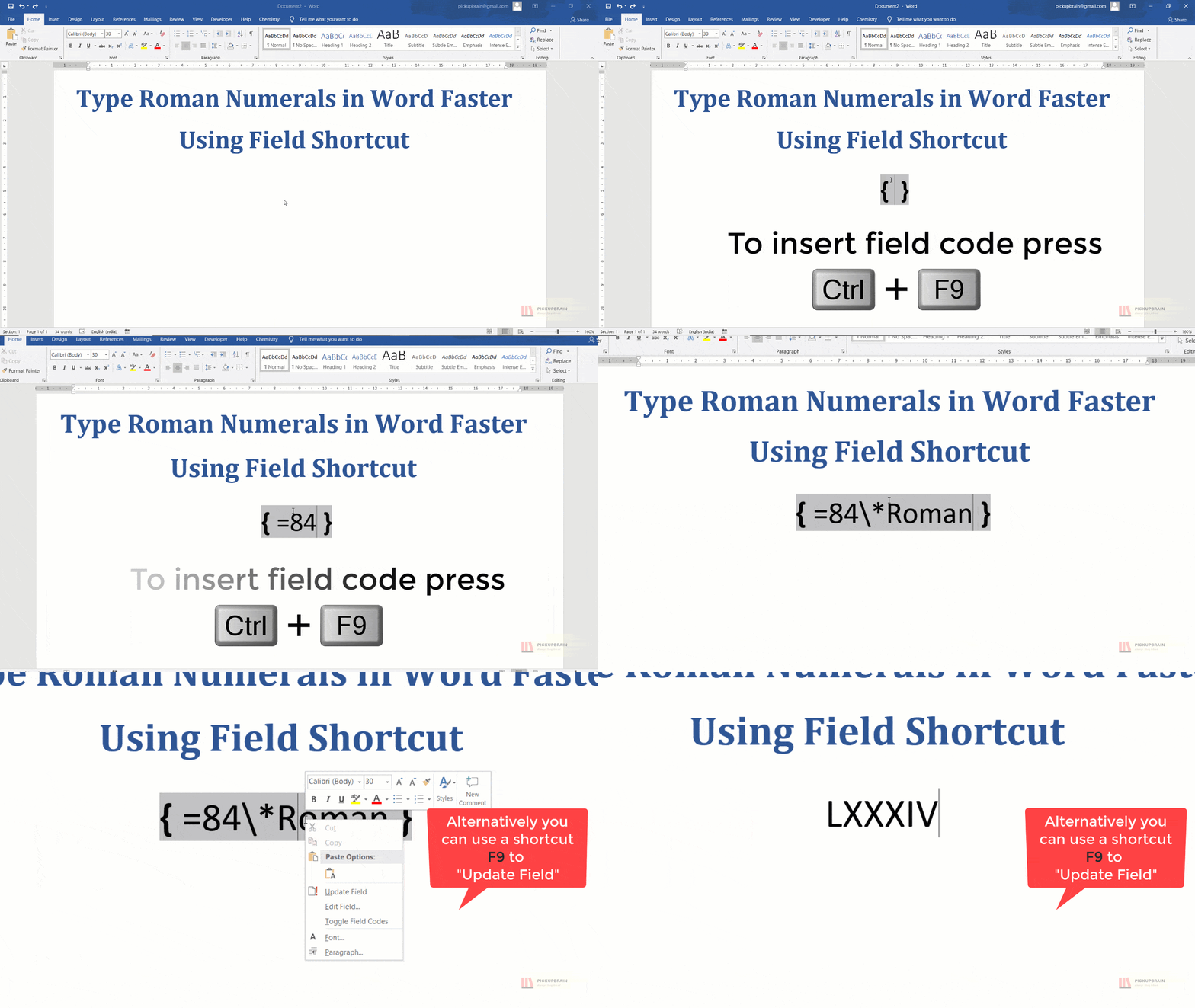
The original animation above illustrates inserting a field and updating it. Word’s field-format documentation explains the \* ROMAN and \* roman number switches.
Roman numeral conversion examples
| Arabic number | Roman numeral | Word field code (inside actual field braces) |
|---|---|---|
| 4 | IV | =4 \* ROMAN |
| 9 | IX | =9 \* ROMAN |
| 14 | XIV | =14 \* ROMAN |
| 49 | XLIX | =49 \* ROMAN |
| 84 | LXXXIV | =84 \* ROMAN |
| 2024 | MMXXIV | =2024 \* ROMAN |
Roman numerals are commonly written with subtractive notation: IV is 4, IX is 9, and XL is 40. The conversion examples above are intended for conventional small positive integers. The traditional Roman numeral system has no universally used ordinary representation for zero or negative numbers; avoid promising arbitrary-number conversion.
Uppercase versus lowercase Roman numerals
The format switch is case-sensitive. In a Word field, \* ROMAN generates uppercase numerals, such as XIV for 14, while \* roman generates lowercase output, such as xiv. A plain-text “xiv” typed by hand will not update automatically if you change the underlying number.
Method 2: Use Roman numerals for page numbers
For a thesis introduction or front matter, do not insert a separate numeric-conversion field on every page. Instead, open Insert > Page Number, then choose the Page Number Format option and select i, ii, iii or I, II, III, as available in your Word edition. If the main body should restart at page 1 with ordinary Arabic numerals, create suitable sections and format their page numbering separately.
A page-number field such as { PAGE \* roman } is different from the calculation field { =84 \* ROMAN }: the former displays a changing page number; the latter formats a specific numeric result. For a detailed guide, see starting page numbering later in Word.
Method 3: Insert Unicode Roman numeral characters
Unicode includes numeral characters such as Ⅰ (U+2160) and Ⅳ (U+2163), which are different underlying characters from the Latin letters I and IV. For most ordinary Word documents, the Latin-letter spelling is easier to search, edit and copy. Use Unicode numeral symbols only when the exact symbol is needed for your typography or notation.
Original Word examples and troubleshooting
The historical examples and troubleshooting section below have been retained, with an obvious contradictory wording error corrected. Some older screenshots use a different Word ribbon layout.
Roman Numeral Examples
| Arabic number | Roman numeral |
|---|---|
| 4 | IV |
| 9 | IX |
| 49 | XLIX |
| 84 | LXXXIV |
| 2024 | MMXXIV |
Uppercase and Lowercase Roman Numerals
Use the field switch \* ROMAN for uppercase output and \* roman for lowercase output. For example, { =14 \* roman } produces xiv when updated. The curly braces shown in this example represent actual Word field braces.
Troubleshooting Word Field Codes
- You see a formula instead of a numeral: Press Alt+F9 to toggle the display of field codes, or right-click the field and choose Toggle Field Codes.
- Nothing changes: Click the field and press F9 to update it; some laptops require Fn+F9.
- The result seems incorrect: Check the arithmetic value and the field syntax. For 84, the standard Roman numeral is LXXXIV, not an incorrect variant of the numeral.
- Using Word for the web: Field creation and editing are more limited than in desktop Word.
Common problems when converting numbers
- Ctrl + F9 creates nothing: make sure Word has focus and use the proper Fn modifier if your keyboard requires it.
- The field still shows code: toggle field display with Alt + F9, then use F9 to update the selected field.
- Braces do not work: typed braces are just text; insert a real field with Ctrl + F9.
- Wrong case: change the format switch to
\* ROMANor\* romanand update the field. - Mac or Word for the web: field creation and shortcut support may differ, so use desktop commands available in your installed version.
- Page numbers change unexpectedly: check section breaks and page numbering formats rather than relying on a fixed number-to-Roman calculation.
Frequently asked questions
What is 84 in Roman numerals? LXXXIV. What is 2024? MMXXIV. Can I type Roman numerals manually? Yes; field conversion is useful only when you want a computed value or repeated updating. Are Roman numerals the same as a Roman font? No. The numeral system is independent of fonts such as Times New Roman.
Summary
For automatic number conversion, insert a Word field with Ctrl + F9 and use \* ROMAN or \* roman. For document page numbering, use Word’s dedicated page-number format settings. For simple Roman numerals in a paragraph, typing ordinary Latin letters may be the best choice.
Related Posts

C P Gupta is a YouTuber and Blogger. He is expert in Microsoft Word, Excel and PowerPoint. His YouTube channel @pickupbrain is very popular and has crossed 9.9 Million Views.