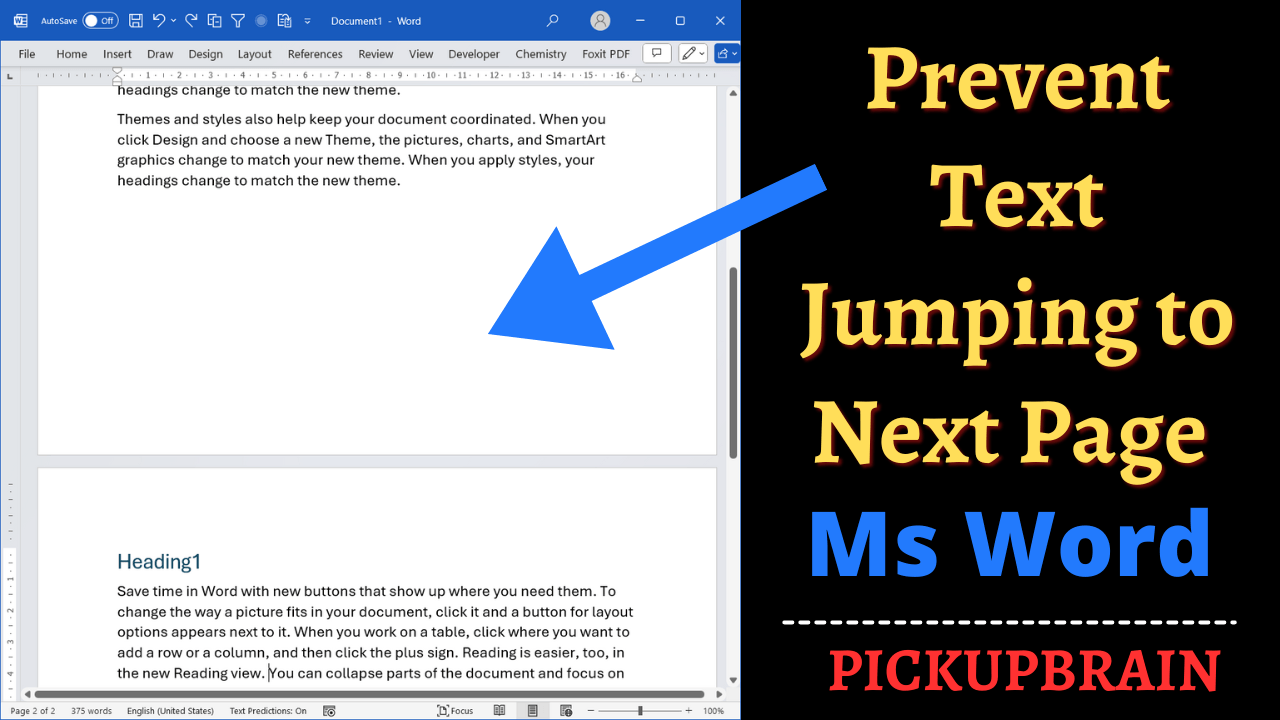
When Microsoft Word unexpectedly moves text to the next page, the cause is often a manual break or a paragraph pagination setting. Start by showing formatting marks, then check the affected paragraph’s Line and Page Breaks options. This guide explains how to identify the cause without disrupting the rest of your document.
Follow these troubleshooting steps in order, beginning with the quickest checks.
Key Takeaways:
- Text jumping often happens due to hidden formatting, paragraph settings, or page breaks.
- Fix this issue by inspecting paragraph pagination settings and manual page or section breaks first. Adjust line spacing only if it is actually causing the overflow.
Why Does Text Jump to the Next Page in Word?
Text often jumps to the next page due to the following reasons:
- Page Breaks: Either manual or automatic page breaks forcing text onto a new page.
- Pagination Settings: Incorrect settings like “Keep with next” or “Widow/Orphan Control.”
- Hidden Formatting: Extra spaces, section breaks, or invisible formatting marks.
Identifying the root cause is the first step in stopping the issue.
How to Stop Text from Jumping to the Next Page in Word: Step-by-Step
Step 1: Reveal Hidden Formatting
Before fixing the issue, you need to see what’s causing it. You can reveal hidden formatting by turning on Show/Hide Formatting Marks as follows.
- Go to the Home tab.
- Click on the Show/Hide (¶) button.
- This will reveal spaces, page breaks, and other formatting marks.

This allows you to see if there’s an unwanted manual page break or extra paragraph marks pushing the text to the next page.
Step 2: Remove Unwanted Page Breaks (Reason 1)
One of the most common causes of text jumping is an accidental page break, section break (next page) or paragraph marks.
- If you see a Page Break (—— page break ——-), section break (next page) or paragraph marks (¶), place your cursor just before the break.

- Press Delete to remove it.

Step 3: Adjust Paragraph Settings (Reason 2)
Sometimes, Word’s paragraph settings force text to the next page. Here’s how to check and fix them:
- Select the paragraph/text that’s jumping to the next page.
- Right-click and choose Paragraph.
- Go to the Line and Page Breaks tab.
- Check these options and change only the setting causing the unwanted page break:

- Widow/Orphan Control: Prevents single lines from being stranded at the top or bottom of a page. Usually leave it enabled; change it only if that behavior is specifically causing a layout problem.
- Keep with next: Keeps the selected paragraph on the same page as the following paragraph. Check it if a heading and its following text move together unexpectedly.
- Page break before: Forces a paragraph to start on a new page. Disable it if you do not want that forced break.
- Click OK to apply the changes.

Step 4: Check Table and Image Layout
If text moves after inserting a table or image, check the object’s layout settings and available space on the page. Large tables, floating images, and paragraph settings can affect page flow:
- Right-click on the table or image.
- For an image, open Wrap Text or Layout Options. For a table, open Table Properties.
- For images, try In Line with Text to simplify layout. For tables, review row-breaking options and the paragraph settings around the table.
Common Problems and Solutions
1. Text Still Jumps After Adjusting Settings
If the text continues to jump, try the following:
Solution 1:
- Reset the style for the paragraph by applying Normal Style from the Home tab.
- Look for hidden section breaks or additional manual page breaks.
Solution 2:
Sometimes the issue is caused by the paragraph following the text that moves, rather than by the text itself.
- Select the remaining text in the next page
- Right click and select paragraph setting go to Line and Page Breaks tab
- Check Keep with next, Keep lines together, and Page break before. Change only the setting responsible. Leave Widow/Orphan Control on unless there is a specific reason to disable it.
2. Text Moves to the Next Page After a Heading
Headings are often programmed with “Keep with next” to ensure they stay with the following paragraph. To fix this:
- Select the heading.
- In the styles, right click the heading style that is highlighted (heading style applied to selected text automatically highlights in styles).

- Go to Format > Paragraph…

- In Paragraph settings (as described above), uncheck Keep with next only if you intentionally want the heading to separate from the following paragraph. Usually, keeping headings with their text improves readability.
- Click ok to close Paragraph and Style windows.


3. Text Jumps After Editing
Sometimes, small edits can cause text to shift unexpectedly. Always check for hidden formatting marks after making changes.
Advanced Methods to Prevent Text Jumping to Next Page
Method 1: Understand “Keep Lines Together”
If a paragraph must stay on one page, enable Keep lines together. If a long paragraph moves entirely to the next page and leaves a large gap, turn this option off when splitting the paragraph is acceptable:
- Select the paragraph.
- Right-click, go to Paragraph, and under Line and Page Breaks, select Keep lines together.
Method 2: Avoid Manual Breaks
Where possible, avoid adding manual breaks to control page flow. Let Word handle the spacing through Paragraph settings or use Section Breaks when necessary.
Frequently Asked Questions
How do I remove a section break?
- Go to the View tab and select Draft view.
- Select the section break and press Delete. Important: deleting a section break can change page layout, headers, footers, and page numbering. Save a copy first.
Why does my table push text to the next page?
This happens when the table’s size or formatting forces the surrounding text to move. Adjust Table Properties and Text Wrapping to solve the issue as shown in following video.
External Resources:
Accuracy notes and troubleshooting
Safe diagnosis: Turn on ¶ formatting marks and check Page break before, Keep with next, and Keep lines together under Paragraph > Line and Page Breaks. A heading is normally kept with the paragraph after it, so avoid switching that off globally. If a section break causes the move, inspect page orientation and headers/footers before deleting it; section breaks carry formatting.
Ms Word tips you may like

C P Gupta is a YouTuber and Blogger. He is expert in Microsoft Word, Excel and PowerPoint. His YouTube channel @pickupbrain is very popular and has crossed 9.9 Million Views.
While I’m typing, letters to words suddenly start to line up on the right side. As this is happening, blank pages are forming as the line of words keeps going. Then I press the Tab key and click on the back key, and the words come back. All this is happening while writing words within a sentence.
Thats strange. I don’t know what is happening.
Thanks a ton for this page.
‘Paragraph’, ‘Line and Page Breaks’ was the perfect solution for me.
Welcome dear and thanks for leaving comments.