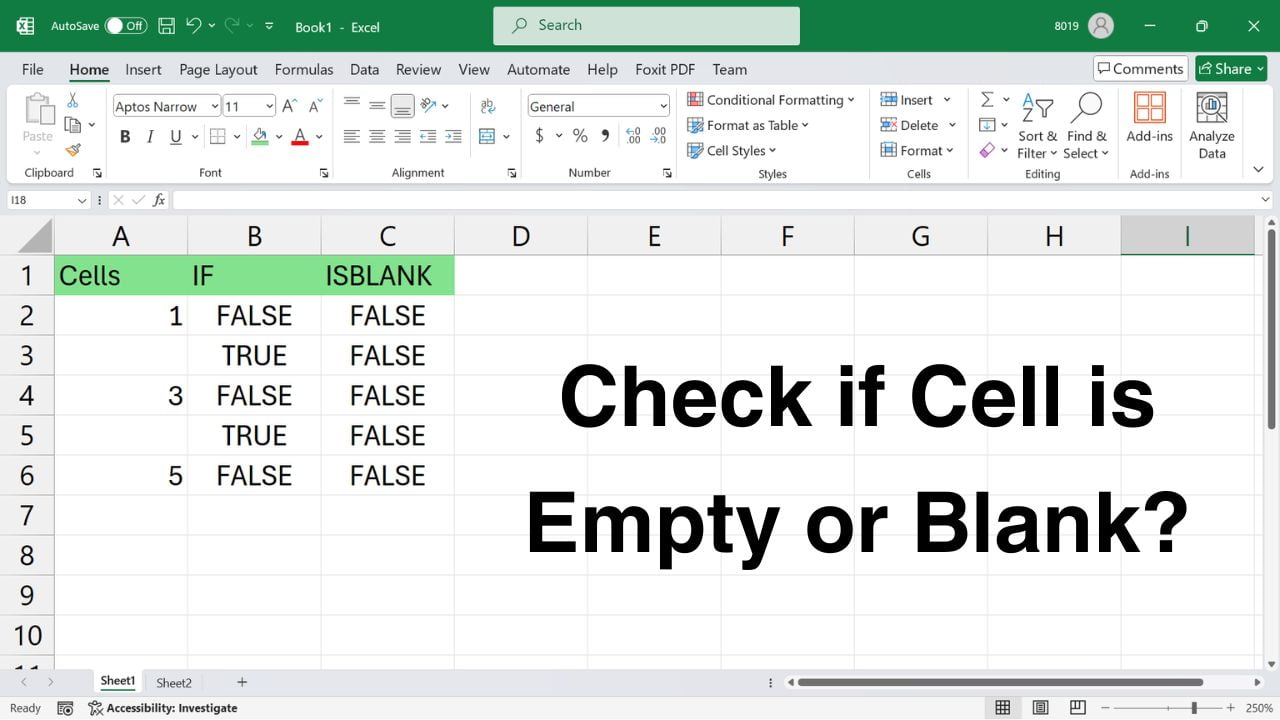
Quick answer: Use =ISBLANK(A2) to test whether an Excel cell is genuinely empty. Use =A2="" if you also want to treat a formula returning an empty string as blank. This guide explains both checks, practical IF formulas, and why cells that look empty may behave differently.
Method 1: Check physically empty cells with ISBLANK
Microsoft documents the blank-cell check in its IF and ISBLANK guidance. The formulas below work in modern Excel desktop and web versions; menu paths may vary by platform.
Excel’s ISBLANK function returns TRUE when the referenced cell contains no value or formula, and FALSE otherwise. A formula returning "" is still a formula, so ISBLANK returns FALSE.
Syntax
=ISBLANK(value)
Example: =ISBLANK(B5)
Method 2: Treat empty-string formula results as blank
Use this method when your data contains formulas such as =IF(B2=0,"",B2) that intentionally display an empty string. It checks the evaluated value rather than whether the cell is physically empty.
You can use IF to display different messages depending on whether a cell appears blank. The condition A2="" also matches a formula that returns an empty string.
The following formula returns the logical value TRUE when A2 is blank or evaluates to an empty string, and FALSE otherwise. The IF wrapper is optional because =A2="" already returns TRUE or FALSE.
Syntax
=A2="" (or =IF(A2="",TRUE,FALSE) if you need the explicit IF structure).
ISBLANK vs A1=””: What’s the Difference?
ISBLANK(A1) returns TRUE only when A1 is genuinely empty. If A1 contains a formula such as ="", ISBLANK returns FALSE because the cell contains a formula. By contrast, =A1="" returns TRUE when A1 is empty or when its formula evaluates to an empty string.
Example: Check Whether a Cell Is Blank
=ISBLANK(A2): TRUE only if the cell has no contents.=IF(A2="","Missing","Entered"): shows Missing for an empty cell or an empty-string result.=LEN(TRIM(A2&""))=0: useful when you also want to treat ordinary spaces as empty; it does not remove every possible nonprinting character.
Troubleshooting Blank-Cell Checks
If a cell looks blank but your formula says it is not, click the cell and inspect the formula bar. It may contain a formula returning "", spaces, or hidden characters. Use Home → Find & Select → Go To Special → Blanks to select genuinely empty cells, but remember that formula cells returning an empty string are not truly blank.
Related: display a blank instead of zero in Excel and count nonblank cells with COUNTA and COUNTIF.
Worked example: missing values in an order tracker
Suppose column B contains a delivery date. In C2, enter =IF(B2="","Awaiting date","Scheduled") and fill down. A genuinely empty B2 and a B2 formula returning "" both display Awaiting date. If you need to flag only cells that contain no formula or value at all, use =IF(ISBLANK(B2),"Not entered","Contains a value or formula") instead.
Blank-cell test comparison
| What A2 contains | =ISBLANK(A2) | =A2="" |
|---|---|---|
| Nothing (truly empty) | TRUE | TRUE |
Formula ="" | FALSE | TRUE |
| One space | FALSE | FALSE |
| Number 0 | FALSE | FALSE |
| Text such as Pending | FALSE | FALSE |
Note: An apostrophe-only entry, imported data or cells with hidden characters can behave differently from truly empty cells. Inspect the formula bar and test your actual data. COUNTBLANK also counts cells containing formulas that return "", whereas ISBLANK returns FALSE for those cells.
Frequently asked questions
Does ISBLANK count a cell with a formula as blank?
No. Even if the formula displays nothing by returning an empty string, the cell contains a formula and ISBLANK returns FALSE.
How do I ignore cells that contain only spaces?
For ordinary spaces, use =LEN(TRIM(A2&""))=0. Imported nonbreaking spaces (character 160) may require additional cleaning, for example =LEN(TRIM(SUBSTITUTE(A2&"",CHAR(160)," ")))=0. These checks treat whitespace as missing data rather than identifying a truly empty cell.
Can I use the same formulas in Excel for the web?
Yes. These standard worksheet formulas work in current Excel desktop and web versions. Depending on your regional settings, Excel may use semicolons rather than commas to separate function arguments.
Related Posts
Which blank-cell test should you choose?
Choose ISBLANK when you must distinguish a never-entered cell from a formula cell. Choose =A2="" for display-oriented checks that treat empty-string results as missing. For whitespace-only text, use a carefully tested TRIM or SUBSTITUTE expression. Avoid deleting rows solely because a formula displays an empty string; that cell may contain useful logic.
Practical test: blank cells, empty strings and errors
Build a small test sheet: leave A1 untouched; enter ="" in A2, 0 in A3, one space in A4, and =NA() in A5. In B1 enter =ISBLANK(A1) and fill down; only B1 should show TRUE. In C1 enter =IFERROR(A1="","Check error") and fill down. C1 and C2 should show TRUE; C3 and C4 should show FALSE; C5 should show Check error. This distinguishes a missing value from an error instead of silently treating the error as an empty cell.
Important: IFERROR catches worksheet errors, so use it only when an explicit error message or fallback is appropriate. If errors need investigation, use =A1="" without masking them. Keep a numeric zero distinct from missing data, and test imported text separately for nonbreaking spaces.
Quick decision checklist
- Truly empty only:
=ISBLANK(A2). - Empty or formula returning an empty string:
=A2="". - Ordinary whitespace-only text:
=LEN(TRIM(A2&""))=0, after confirming whether errors or imported special spaces are possible.

C P Gupta is a YouTuber and Blogger. He is expert in Microsoft Word, Excel and PowerPoint. His YouTube channel @pickupbrain is very popular and has crossed 9.9 Million Views.