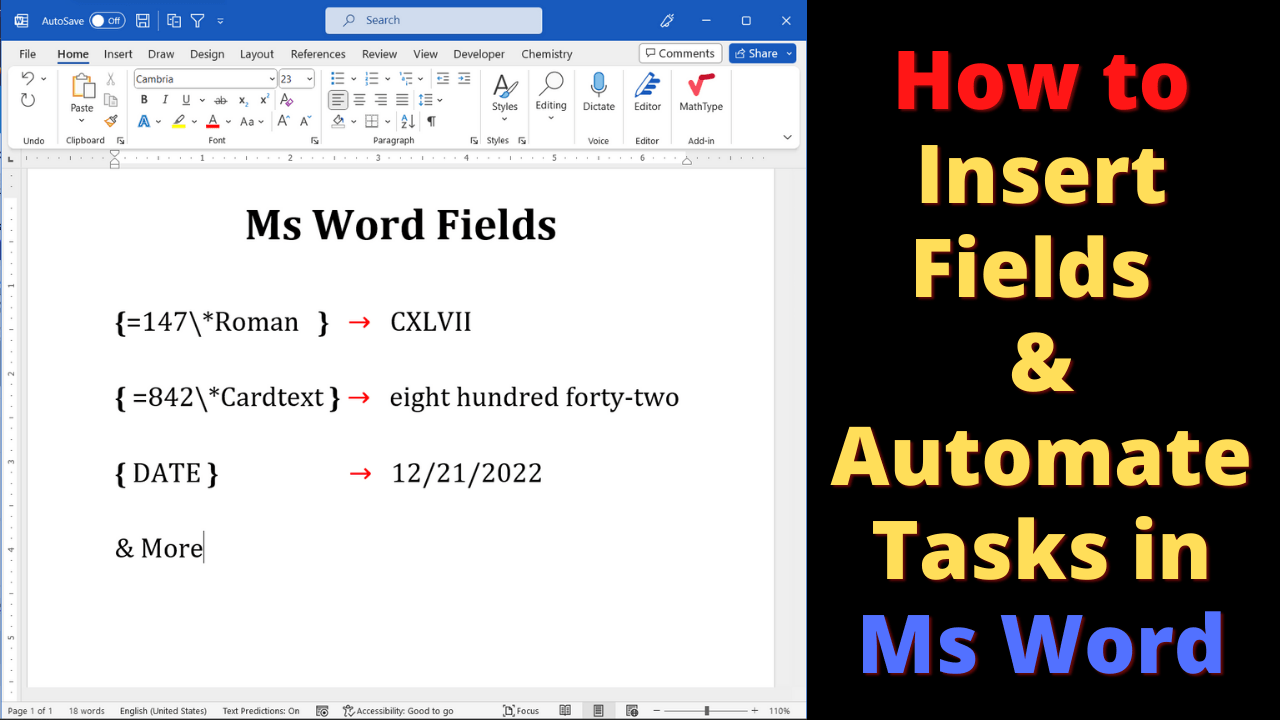
Microsoft Word fields can insert automatically calculated information such as page numbers, dates and cross-references. Learn how to insert field codes correctly, update results, and choose fields that match your document’s purpose.
Two ways to insert fields in Microsoft Word
Fields power dynamic information such as page numbers, dates, references, and parts of tables of contents. Unlike ordinary text, field results can change when Word updates them. You can insert a named field using Word’s interface or create field braces with a keyboard shortcut. Use the method available in your desktop edition of Word.
- Using Word’s Insert menu
- Keyboard shortcut (Ctrl + F9)
Method 1: Insert a named field from the menu
In desktop Word for Windows, use the Field dialog to choose a field name and any supported formatting options:
- Place your cursor at the desired location where you need to insert field.
- Go to Insert > Quick Parts > Field (not “Fields”) and choose the required field type. This inserts a configured field rather than an empty field brace pair.


Method 2: Insert field braces with a shortcut
To insert genuine empty field braces, use the shortcut below, type a supported field code between the braces, then update with F9. Typing ordinary curly braces will not create a working field.
- Windows: Ctrl + F9
- MacOS: ⌘ + F9 (Command + F9)
Useful Word field codes with examples
These are illustrative field codes; insert the braces using Word’s field command, enter the code, then press F9 to update. Date, time, page count, file size and word count are document-dependent, so example results will vary. Some field codes also accept format switches.
| To Do | Field Code Example | Result (After pressing F9) | Remark |
|---|---|---|---|
| Calculation | { = 15.3 * 5 +2 } | 78.5 | Insert your calculation after = Use ^ for power |
| Number to Text | { = 187 \\* CardText } | one hundred eighty-seven | |
| Roman Numerals from Indo-Arabic | {=147\*Roman} | CXLVII | |
| Today’s date | {DATE} | 12/21/2022 | Format is MM/DD/YYYY. Keyboard shortcut: ALT+SHIFT+D (Windows) and Control+Shift+D (MacOS) |
| Today’s time | {TIME} | 7:12 PM | Keyboard shortcut: ALT+SHIFT+T (Windows) and Control+Shift+T (MacOS) |
| Page number | {PAGE} | 2 | |
| Number of words in current document | {NUMWORDS} | 545 | |
| Number of pages in current document | {NUMPAGES} | 2 | |
| Name of current file/document | {FILENAME} | Document1 | |
| Size of file/document | {FILESIZE} | 14249 | File-size display depends on the field format switch; do not assume every displayed value is bytes. |
Field troubleshooting: five common questions
Why do I see a field code instead of a result? Press Shift + F9 with the field selected to toggle its display. Why does a field show an error? Check the field name, required switches, and any referenced bookmark or source. Why is the date unexpected? DATE, CREATEDATE and SAVEDATE represent different values. Why are header fields unchanged? Main-body selection may not include headers, footers or text boxes; update those separately. Why does F9 not work? On some keyboards, use Fn + F9. Save a copy before unlinking fields with Ctrl + Shift + F9.
Related Posts
Worked example: insert a page number field
In desktop Word for Windows, open a practice document and place the cursor in the footer. Press Ctrl + F9 to create field braces, type PAGE between them, and press F9. The displayed page number should reflect the current section’s numbering settings. Add a page or change section numbering, update the field again, and check the result in Print Preview. For a ready-made footer, Insert > Page Number is usually simpler.
DATE, CREATEDATE and SAVEDATE are not interchangeable
DATE represents the current date when the field is updated; CREATEDATE and SAVEDATE refer to document properties. Use a fixed date as ordinary text when the document must preserve a historical signing or submission date. Check the displayed format and locale before distributing legal or audit-sensitive documents.
Update, inspect and troubleshoot fields
Code appears instead of the result: Select the field and press Shift + F9. Alt + F9 toggles all field codes in desktop Word for Windows.
Result is stale: Select the field and press F9. Ctrl + A followed by F9 updates many fields in the main document, but headers, footers and text boxes may need separate attention.
Reference source not found: Check that the referenced bookmark, heading or caption still exists.
Function key does nothing: Some keyboards require Fn + F9; Mac and web editions may expose different field-editing controls.
Before publishing or printing, check page numbers, cross-references and dates in a copy of the document. See the field update guide and field keyboard shortcuts for related workflows.

C P Gupta is a YouTuber and Blogger. He is expert in Microsoft Word, Excel and PowerPoint. His YouTube channel @pickupbrain is very popular and has crossed 9.9 Million Views.