Need to edit a PDF as a Word document? You can open a text-based PDF in Microsoft Word without installing a separate PDF converter if you already have a compatible desktop version of Word. Alternatively, some online services offer free conversion with usage limits. The right method depends on the document’s layout, privacy, and whether it is a scan.
Method 1: Convert PDF to Word using Microsoft Word
Best for: text-heavy PDFs and people who already have Word 2013 or later on Windows, including Word 2016, 2019, 2021, 2024, or Microsoft 365. This method does not mean Microsoft Word itself is free. Word creates an editable copy while leaving the original PDF unchanged.
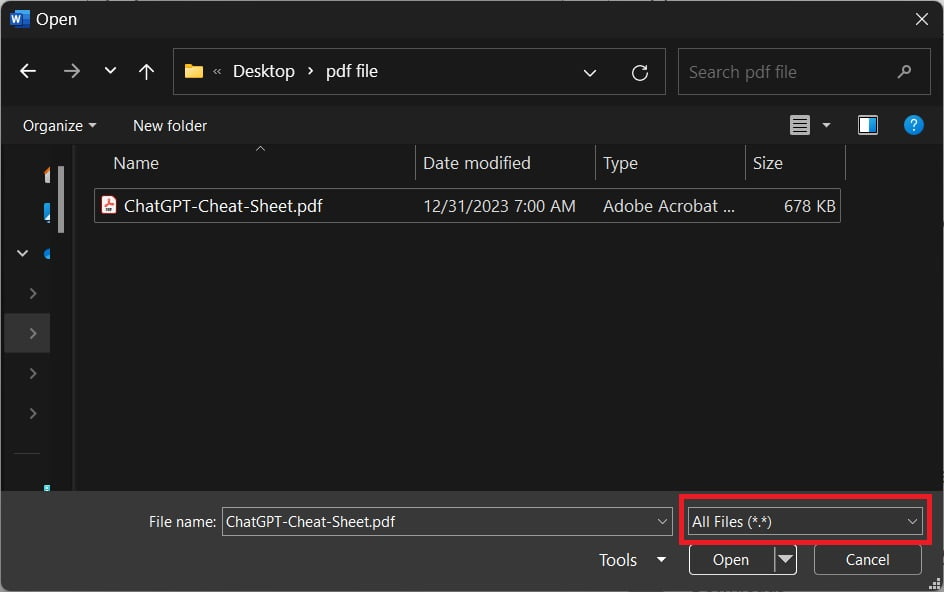
- Open Microsoft Word and choose File > Open > Browse. You can also press Ctrl + O in many Windows versions.
- Locate your PDF, select it, and click Open. If the file does not appear, change the file-type filter to show PDF or all supported files.

- Read Word’s notice that the PDF will be converted into an editable document and the layout might change. Choose OK to continue.
- If you see Protected View, click Enable Editing only if you trust the source. Do not confuse Enable Editing with Enable Content, which relates to active content or macros.
- Check tables, text boxes, headings, fonts, page breaks, and images. Fix formatting problems before using the result.
- Choose File > Save As and save a Word Document (.docx) with a new name.
Microsoft notes that PDF conversion works best on files that are mostly text. See Microsoft’s guide to opening PDFs in Word. For a deeper walkthrough, visit our Microsoft Word PDF conversion guide.
Method 2: Use a free online PDF-to-Word converter
Online tools can be helpful when Word is unavailable, but do not upload confidential, financial, medical, legal, or workplace documents unless your organization permits it and you understand the service’s privacy and retention terms. Free tiers, file-size limits, and OCR availability can change.
- Visit a PDF-to-Word service you trust, such as Smallpdf or PDF2DOC. Another service you may evaluate is Zamzar.
- Check whether the conversion is available on the free plan, how files are processed and deleted, and whether you must register.
- Use Choose File, Upload, or the service’s equivalent control to select a non-sensitive PDF.
- Start the conversion and download the output as a .docx document.
- Open the resulting file in Word or another compatible editor. Compare it against the original PDF, especially if it contains columns, tables, equations, or graphics.
What about scanned or image-only PDFs?
A PDF containing photographed or scanned pages may not contain selectable text. Optical character recognition (OCR) is often required to turn the image into editable text. Results vary with image quality, language, handwriting, and software; do not assume every online converter includes OCR in its free plan.
- If you can select and copy words in the PDF: try opening it in Word first.
- If an entire page selects as one image: use a trusted OCR-capable application or service, then check the recognized text carefully.
- If the layout is complex: consider editing the original source document instead, if available.
Common conversion problems and fixes
Tables are distorted. Word reconstructs a table from a PDF’s visual layout, which may not preserve the original table structure. Check row/column boundaries, merged cells, and text alignment.
Page breaks or fonts changed. PDF is a fixed-layout format; an editable Word document uses text flow. Compare pages after conversion and check fonts, section breaks, and paragraph spacing.
The file opens as pictures instead of editable text. The PDF may be scanned or heavily graphics-based. You may need OCR, and even then manual proofreading is essential.
You cannot click or type in the Word document. Check whether it is in Protected View and whether you have permission to edit it. For a trusted file, use Enable Editing; if the document is restricted by an owner or administrator, request access.
Hyperlinks or bookmarks disappeared. Verify navigation links, footnotes, and references after conversion. Some interactive PDF elements do not convert into equivalent Word features.
Five-minute quality check after conversion
Before sharing a converted document, compare the original PDF and the new DOCX side by side. This is particularly important for reports, contracts, forms, and scientific documents. A successful file conversion does not prove that every number or page is correct.
- Compare the beginning, middle, and end: confirm that all pages and paragraphs are present and that no text was duplicated or omitted.
- Check critical details: compare dates, decimal points, negative signs, currency values, superscripts, footnotes, and special symbols against the PDF.
- Inspect layout: review tables, page breaks, headers, figures, captions, and multi-column sections. Correct the editable document rather than assuming it matches the PDF.
- Check structure and accessibility: use actual Word heading styles, meaningful link text, table headers where appropriate, and alternative text for informative images. A PDF’s visual headings do not necessarily become Word heading styles.
- Save and reopen: save as DOCX, close and reopen it, and verify that edits remain possible. If you export back to PDF, check the exported result separately.
Worked example: compare a converted report against its PDF
For a safe practice run, create a two-page Word document containing a heading, a three-column table with sample figures (for example, 12.50, −3.25 and 0.75), a hyperlink, and a page number. Save it as a PDF, then reopen that PDF using File > Open in desktop Word. This creates a controlled source you can compare with the converted DOCX without uploading confidential information.
- Content: check that each heading, number, minus sign and hyperlink is present and correct; a similar-looking dash can change the meaning of a calculation.
- Structure: inspect the table cells and apply real heading styles if the converted headings are only visually bold.
- Pagination: compare page breaks and the page number field. Reconstructed content can flow differently from the original fixed-layout PDF.
- Output: save a separate DOCX, close it, reopen it and confirm you can edit text. Do not overwrite the original PDF.
Important distinction: this exercise checks conversion of a PDF exported from editable text; it does not establish that the same method will recover text from scanned pages. For scans, use an approved OCR workflow and proofread every critical value.
Which PDF-to-Word method is best?
- You already have desktop Word and the PDF is mostly text: start with Word’s built-in import; you do not need an extra converter.
- You do not have Word and the file is non-sensitive: an online tool can work, subject to its current free-plan limits.
- The file contains sensitive information: prefer approved local software instead of an arbitrary upload service.
- The PDF is a scan: choose an OCR-capable workflow and proofread the result carefully.
Frequently asked questions about PDF-to-Word conversion
Can I convert a PDF to Word without uploading it online?
Yes. If you already have a compatible desktop version of Microsoft Word, open the PDF locally using File > Open. Word converts it to an editable document; keep the original PDF as a reference. Conversion may still alter the layout.
Is PDF-to-Word conversion free?
Some online services offer limited free conversions, but the limits can change. Word’s built-in PDF import requires access to a compatible Word installation or subscription; it is not a separate free Word license.
Why is converted text not editable?
The source may be an image-only scan, so optical character recognition (OCR) is needed. Even after OCR, check names, numbers, punctuation, and tables against the original because recognition errors are common.
Conclusion
For most ordinary text PDFs, start with File > Open in a compatible version of Microsoft Word. Save the result as .docx and review its formatting. Online services are an alternative for non-sensitive files, but always check the current limits and privacy terms. Keep your original PDF so you can compare the converted copy.
Related Posts

C P Gupta is a YouTuber and Blogger. He is expert in Microsoft Word, Excel and PowerPoint. His YouTube channel @pickupbrain is very popular and has crossed 9.9 Million Views.