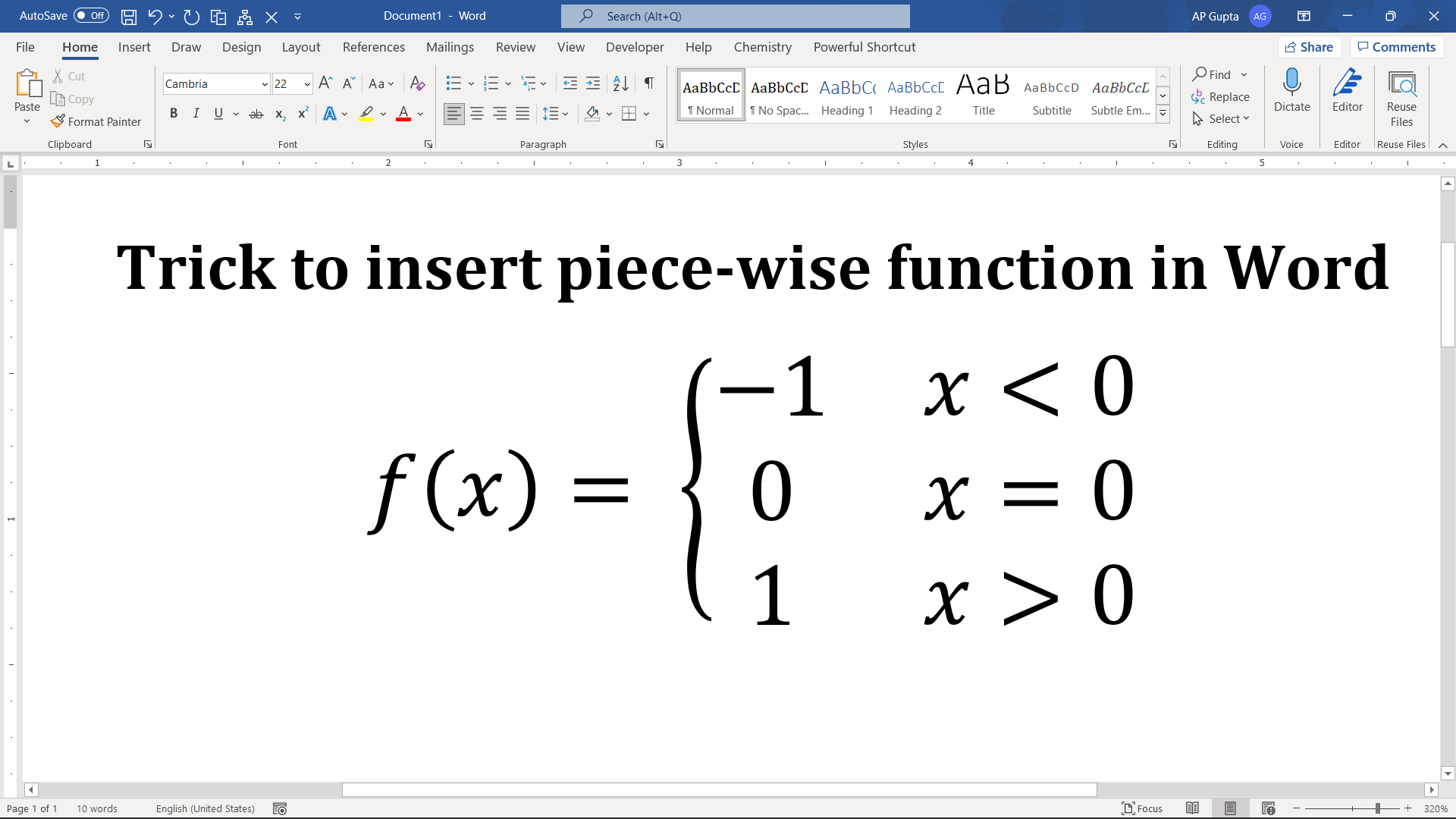
A piecewise function uses different formulas for different conditions, such as f(x) = x² when x ≥ 0 and f(x) = −x when x < 0. In Microsoft Word, build it with an equation and a cases or left-brace template, rather than spaces or a text box. The steps below apply primarily to desktop Word; ribbon names vary by version.
Insert a piecewise function using Word’s equation editor
Step 1. Place the insertion point where the function should appear. For an equation on its own line, use a separate paragraph.
Step 2. Choose Insert > Equation. In Word for Windows, Alt + = opens an equation region. On Mac, use the Insert menu if the Windows shortcut does not apply.
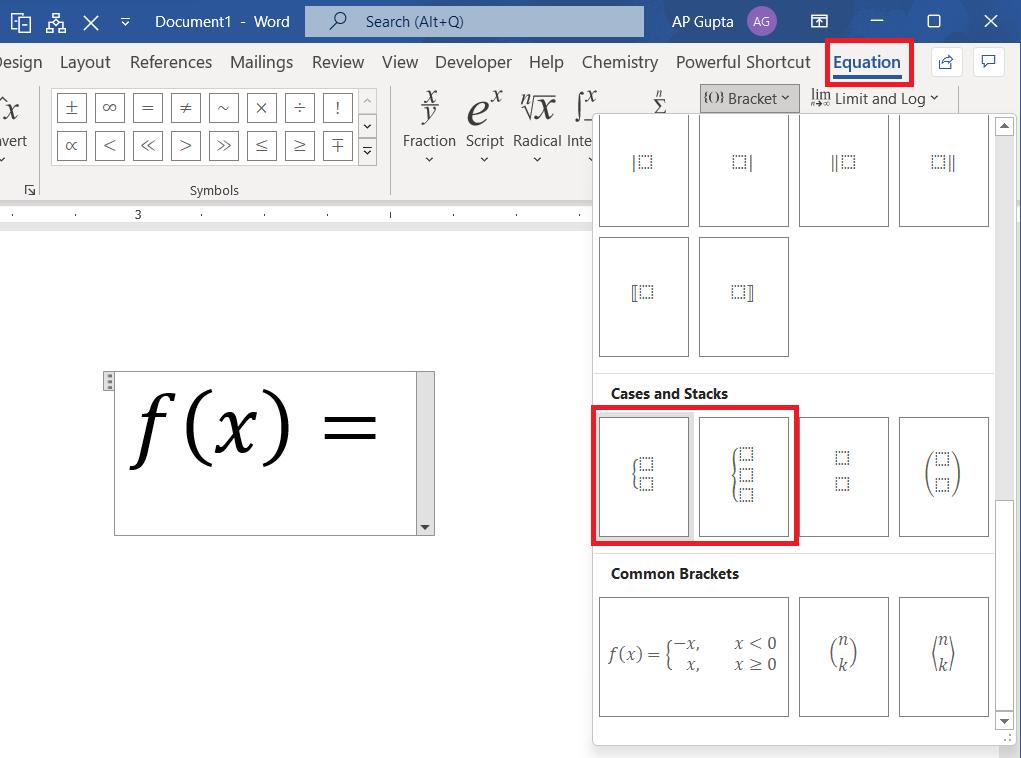
Step 3. Type f(x) = and, while still in the equation region, open the contextual Equation / Equation Tools ribbon. Under Bracket, look for a left curly brace or a Cases and Stacks template. Choose a structure with a left brace and two aligned rows. Some Word versions show these templates under a slightly different gallery label.
Step 4. Enter the expression in each row. For example, the first row is x² with condition x ≥ 0; the second is −x with condition x < 0. Use a two-column cases layout if available. To add another case, right-click inside the equation structure and look for an option to insert a row above or below. Menu wording varies.
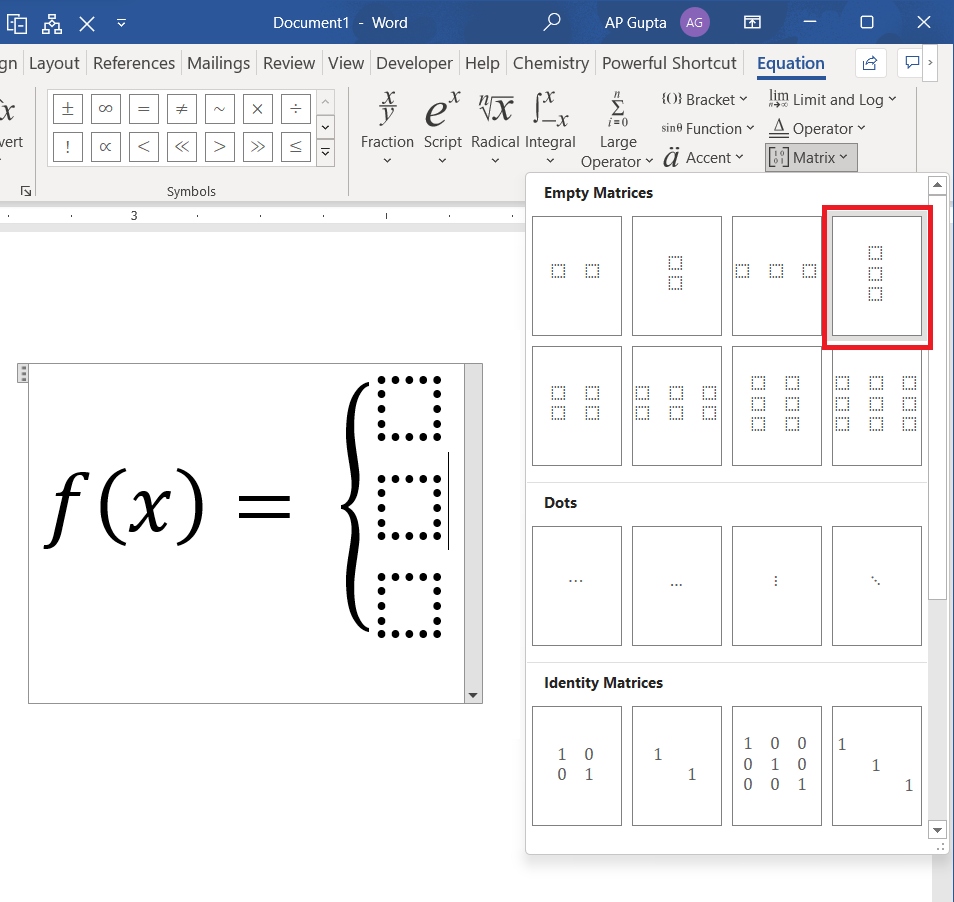
Step 5. If your chosen template contains only one expression column, select a two-column equation matrix for the expression and its condition, positioned beside the left brace. A separate matrix is a fallback, not a required extra column when the cases template already has two columns.
Check that the brace spans all cases and that expressions and conditions align vertically. Avoid using multiple spaces or tabs to simulate a mathematical structure.
Step 6. Click outside the equation to finish. Reopen the equation to edit it later. For accessibility, explain the conditions in surrounding prose, because screen-reader output for complex equations varies by application and export format.
Worked example: a two-case function
Consider f(x) = x² for x ≥ 0 and f(x) = −x for x < 0. In a two-column cases layout, place x² opposite x ≥ 0 on the first row and −x opposite x < 0 on the second. The conditions cover all real values of x without overlapping, so the function is defined unambiguously. See also our Word equation editor shortcuts guide.
Check the Mathematics and the Exported Equation
For the example above, check three inputs before publishing: f(−2) = 2, f(0) = 0, and f(3) = 9. At the boundary x = 0, only the first condition x ≥ 0 applies; the second condition is strictly x < 0. This verifies that the cases are mutually exclusive and cover the intended domain. If your own conditions overlap or leave gaps, explain what should happen at those values.
Save the equation as editable Word math rather than a screenshot wherever possible. Reopen the DOCX and confirm that the left brace still spans both rows and that the inequality signs have not changed. Export a PDF and inspect it at ordinary zoom, especially the minus sign and the ≥ symbol. For readers using assistive technology, describe the function in a sentence immediately before or after the equation. Word’s equation accessibility and PDF tagging vary by version, so visually correct output alone is not a complete accessibility test.
Troubleshooting, limitations and accuracy notes
Missing Bracket gallery: click inside the equation first so the contextual equation ribbon appears. Brace too short: use a scalable bracket template rather than a typed { character. Conditions misaligned: use a two-column equation structure, not spaces. Cannot add a row: right-click within the cases/matrix structure and inspect its insertion options; they vary across Word versions. Word for the web: equation editing capabilities differ from desktop Word; use desktop Word for advanced structures if the template is missing.
Frequently asked questions
Can I type a piecewise function as plain text? You can describe one in prose, but the equation editor produces more consistent alignment. Can I add three or more cases? Yes, choose or extend a multirow structure. Why not use a table? A Word table can approximate the layout, but it is less suitable for editable mathematical notation and a scalable brace. Will it export correctly to PDF? Inspect the exported PDF for alignment and readable mathematical content; accessibility support varies.
Related Posts

C P Gupta is a YouTuber and Blogger. He is expert in Microsoft Word, Excel and PowerPoint. His YouTube channel @pickupbrain is very popular and has crossed 9.9 Million Views.