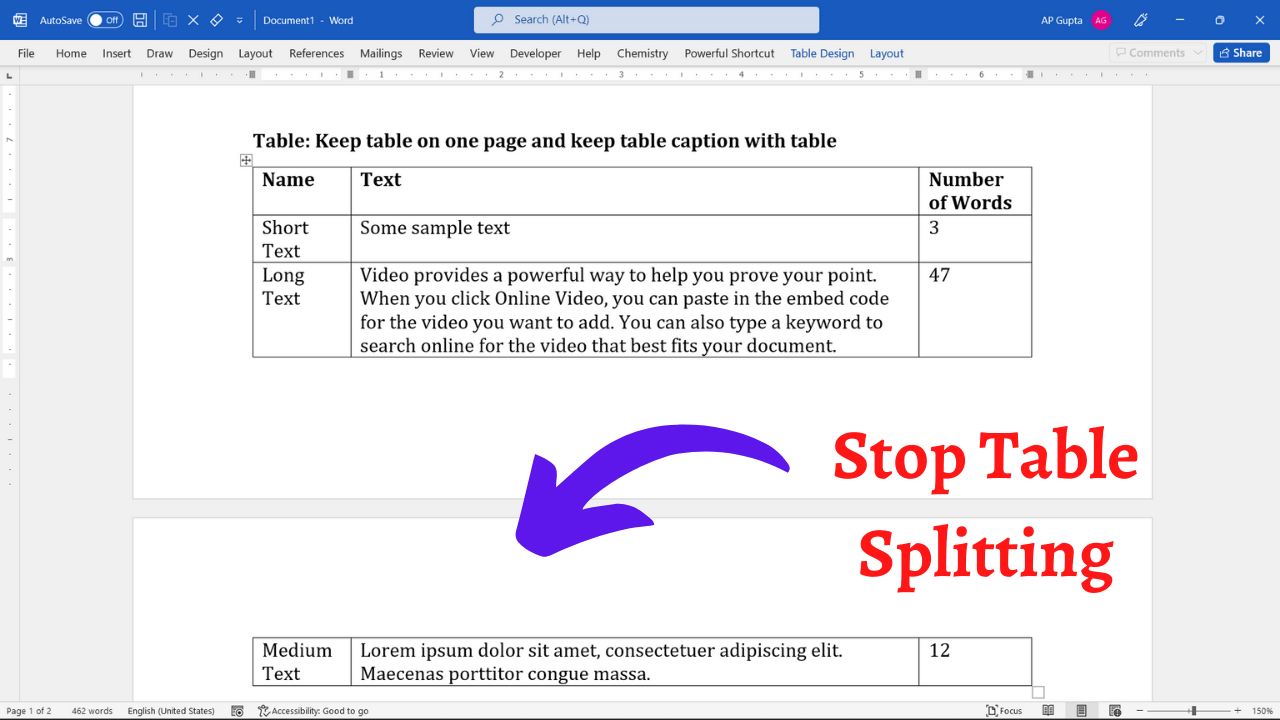
Quick answer: To keep a short table together on one page in Microsoft Word, select its rows, open Home → Paragraph → Line and Page Breaks, and enable Keep with next for the paragraphs in every row except the last. If the table is taller than the available page space, Word cannot fit it on one page without reducing its size, margins, or surrounding content. The steps below explain the setting, a practical test, and its limitations.
How to Keep a Short Word Table Together
Step 1: Select the table using the four-arrow table handle near its upper-left corner. For precise control, select the cell paragraphs in all rows except the last. In multi-column tables, paragraph-level pagination settings can interact across cells; inspect the result in Print Layout rather than assuming that selecting the entire table will always keep it together.
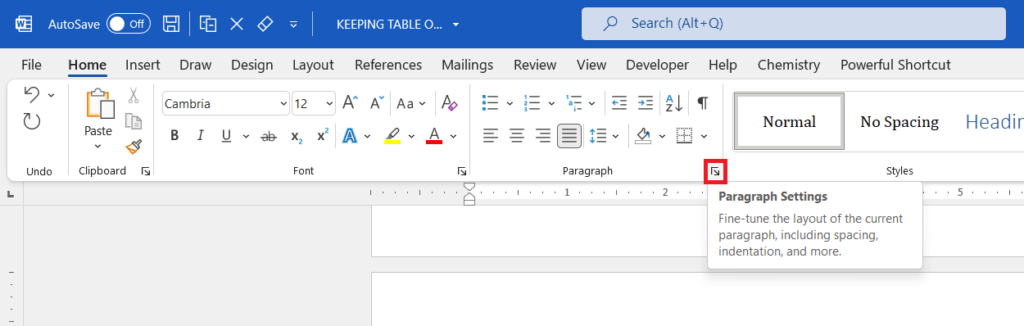
Step 2: On the Home tab, open Paragraph settings using the small dialog launcher in the lower-right corner of the Paragraph group.
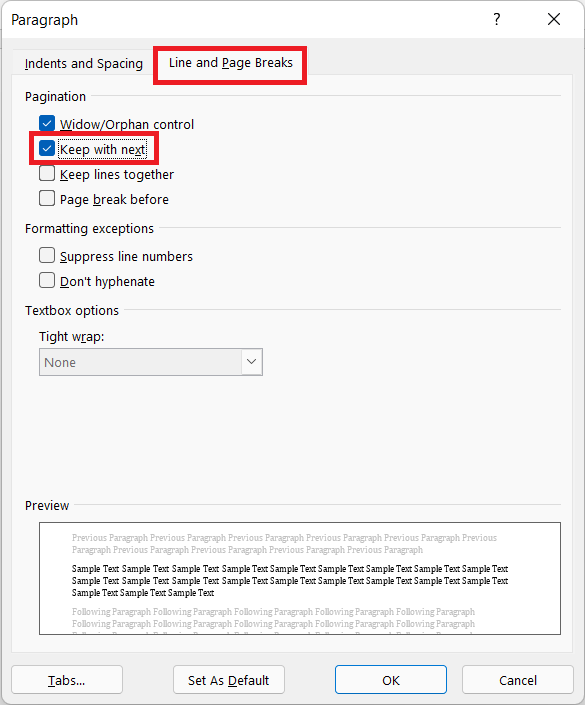
Step 3: Open the Line and Page Breaks tab and enable Keep with next. This links each selected paragraph to the one after it. For tables with several paragraphs in a cell, check which paragraphs the setting affects.
Step 4: Click OK and inspect the table in Print Layout. If the whole table still splits, check whether the table is too tall, whether some cell paragraphs lack the setting, or whether the final row’s paragraphs are also linked to the following paragraph. Avoid applying Keep with next to unrelated text.
Test the setting with a four-row table
Create a new document and insert a two-column, four-row table. Enter short text in every cell. Add several paragraphs before it until the table would otherwise straddle a page break. Apply Keep with next to the relevant cell paragraphs in the first three rows, leaving the last row unlinked to the following body paragraph. Check View > Print Layout, then add or remove a paragraph above the table. A short table should move together when it cannot fit in the remaining space; if it does not, inspect each cell’s paragraph settings. This is a suggested reproducible check, not a claim that every Word version behaves identically.
For a reliable final check, export a PDF and inspect page breaks, header labels, reading order and text legibility. If the table spans pages by design, select the header row and use Table Layout > Repeat Header Rows in desktop Word. Use a real header row rather than manually repeating labels as ordinary body text.
Video Tutorial
Watch the original demonstration of the paragraph setting. Depending on the size and structure of your table, you may also need the troubleshooting steps above.
Prevent a Single Table Row from Splitting Across Pages
If your goal is to keep each row intact rather than the entire table, select the relevant rows, then right-click the table and choose Table Properties → Row. Clear Allow row to break across pages, then click OK. This does not guarantee that all rows stay together; it only prevents an individual row from being divided across pages.
What If the Table Is Too Large for One Page?
Word cannot place a table on one page if its contents require more vertical space than the page provides. Try reducing cell padding, paragraph spacing, or font size; switching the page to landscape; or dividing the table into smaller sections. Avoid shrinking text so much that it becomes difficult to read. If the table spans several pages, consider repeating its header row for clarity.
Troubleshooting Unexpected Blank Space
If a table jumps to the next page and leaves a large blank area, inspect Keep with next and Keep lines together in the paragraphs immediately before and inside the table. Also check for manual page breaks and section breaks. The guide to text jumping to the next page in Word explains these pagination settings in more detail.
Frequently asked questions
Why does Keep with next move the whole table to another page?
Word treats linked paragraphs as a group. When the group cannot fit in the space left on the page, Word moves it to the next page. Check that Keep with next is not also applied to the final row or unrelated following text.
Can I keep a long table on one page without shrinking it?
Not if the table exceeds the printable height. Consider a landscape section, reduced cell margins, or a logical table split. For a multi-page table, repeat its header row instead of reducing the text to an unreadable size.
Does Allow row to break across pages keep the entire table together?
No. That setting keeps each selected row intact but does not prevent a page break between rows. Use Keep with next on the appropriate cell paragraphs when the whole short table must remain together.
Related Posts

C P Gupta is a YouTuber and Blogger. He is expert in Microsoft Word, Excel and PowerPoint. His YouTube channel @pickupbrain is very popular and has crossed 9.9 Million Views.